
A floodlight security camera pairs bright outdoor lighting with video monitoring, but the right choice depends on how much coverage, detail, and setup flexibility you need. I’d put the Ring Floodlight Cam 4K Plus first for buyers prioritizing high-resolution video and 3D motion detection; the eufy Floodlight Camera E340 stands out for dual-lens coverage, while the Wyze Floodlight Camera v2 offers a practical 2K-and-bright-light combination. The biggest tradeoffs are wired installation versus easier setup, broad coverage versus image detail, and subscription-linked features versus local storage options. Light output alone does not guarantee useful footage if motion zones, camera angle, or night conditions are a poor match. Continue reading for the full breakdown and help choosing the right model for your property.

Get everyday essentials delivered free with Prime
- Fast, free delivery on millions of items
- Prime Video, Amazon Music and more included
- Member-only deals all year
Key Takeaways
Video detail separates the premium picks: Ring Floodlight Cam 4K Plus leads this lineup on stated resolution and adds 3D motion detection, while several models focus on 2K or 1080p footage.
Two lenses serve a different purpose than one high-resolution lens: The eufy E340 pairs dual-lens coverage, making it a better match for watching distinct areas than simply prioritizing maximum detail in one view.
Brightest stated output is not the whole decision: Olafus lists 5500 lumens, but buyers should also weigh camera view, motion response, and mounting position; other models pair lower output with different coverage or detection features.
Power and installation divide the lineup: Many picks are wired or hardwired, while Blink Outdoor 4 and Tapo C615F KIT offer alternatives for buyers who want less dependence on existing wiring.
Resolution and feature claims do not settle storage needs: Buyers should check each model’s current recording, notification, and subscription terms before choosing, especially when comparing ecosystems such as Ring, Blink, Arlo, eufy, and Wyze.





| floodlight security camera | Power | Resolution | Light output | Wi-Fi |
|---|---|---|---|---|
| Olafus 360° Dual-Lens Floodlig | Hardwired | 2K | 5,500 lumens | Dual-band 2.4GHz and 5GHz; not Wi-Fi 6 |
| gdend Wired Floodlight Securit | Corded electric, AC 120V/60Hz | 3K UHD | 2,200 lumens | 2.4GHz and 5GHz |
| Ring Floodlight Cam 4K Plus | Wired | Retinal 4K | — | — |
| eufy Security Floodlight Camer | Corded electric, hardwired | — | 2,000 lumens | 2.4GHz |
| Blink Outdoor 4 Floodlight Cam | AA lithium batteries | 1080p HD | 700 lumens | — |
| Ring Floodlight Cam Wired Plus | — | — | — | — |
| eufy Security Floodlight Camer | Corded electric, 20 ft AC cable | Dual 2K telephoto / 3K wide-angle; max 2K with AI tracking | — | 2.4 GHz and 5 GHz, dual-band Wi-Fi 6 |
| Tapo 2K Outdoor Pan/Tilt Wirel | — | 2K | — | 2.4 GHz |
| SZPOWER 2K Floodlight Camera | — | 3MP (2K) | 3500 lumens | — |
| Blink Wired Floodlight Camera | Hardwired; neutral wire required; 100–240 VAC, 50/60 Hz, 45 W | — | — | 2.4 GHz 802.11b/g/n |
| Wyze Floodlight Camera v2 | Hardwired | — | 2,800 lumens | — |
| Arlo Wired Floodlight Security | Hardwired | — | — | — |
More Details on Our Top Picks
Olafus 360° Dual-Lens Floodlight Camera, 2K, Auto Tracking, 5500LM
For a broad driveway, yard, or other open area, I’d favor the Olafus’s dual-lens 360° coverage over a fixed-view camera: fewer blind spots mean fewer areas to check separately. Its 5,500-lumen lights also deliver substantially more stated output than the 2,000-lumen eufy E30, making illumination a priority here. The Olafus pairs that coverage with 2K video, color night vision, and motion tracking, so movement can stay in view after detection. The tradeoff is installation: it needs hardwired power, and local recording requires a separately purchased microSD card. Unlike the eufy E30, it supports both 2.4GHz and 5GHz Wi-Fi, but it does not support Wi-Fi 6. I’d choose it for coverage and light output, not a wire-free or ready-to-record setup.
Pros:- Dual lenses provide 360° coverage to reduce blind spots
- 5,500-lumen floodlights provide high stated light output
- 2K video, color night vision, and auto-tracking support day-and-night monitoring
- Dual-band 2.4GHz and 5GHz Wi-Fi offers more network flexibility than the eufy E30
Cons:- Requires hardwired installation, limiting placement flexibility
- MicroSD card for local storage is sold separately
- Does not support Wi-Fi 6
Best for: Homeowners with a hardwired mounting point who need to monitor a large yard or driveway from a single camera.
Not ideal for: Renters or anyone without access to fixed wiring, and buyers who want local recording ready out of the box.
- Resolution:2K
- Light output:5,500 lumens
- Lens coverage:360°
- Power:Hardwired
- Wi-Fi:Dual-band 2.4GHz and 5GHz; not Wi-Fi 6
- Night vision:Color
- Local storage:MicroSD supported; card sold separately
Our verdict“Choose the Olafus if wide coverage and very bright lighting matter more than easy installation or included local storage.”
gdend Wired Floodlight Security Camera, 3K UHD Outdoor Camera with 2200-Lumen Motion Lights, Color Night Vision, 105dB Siren, IP65 Waterproof, Alexa Compatible
The gdend is a practical pick for buyers who want local recording included and a camera that can actively deter unwanted visitors. Its bundled 64GB SD card avoids the extra storage purchase required by the Olafus, while the 105dB siren adds an audible response alongside motion-triggered lights. The 3K UHD image resolution is also higher on paper than the 2K eufy E30, though the supplied details don’t establish how either performs in every lighting or network condition. Its 2,200-lumen output is useful, but it falls well below the Olafus’s 5,500 lumens, so gdend is less suited to buyers prioritizing maximum area illumination. Wired AC power and Wi-Fi are required; there’s no battery or cellular backup. I’d rank it for its bundled storage and deterrence features, rather than coverage flexibility.
Pros:- Included 64GB SD card supports local recording without a separate card purchase
- 3K UHD resolution exceeds the stated 2K resolution of the eufy E30
- 105dB siren adds an audible deterrent
- IP65-rated housing is designed for outdoor weather exposure
Cons:- Requires wired AC installation and has no battery option
- 2,200-lumen output is lower than the Olafus’s stated 5,500 lumens
- No cellular backup if Wi-Fi is unavailable
Best for: Homeowners who want a wired camera with included local storage, a siren, and weather-resistant outdoor construction.
Not ideal for: Buyers who need battery-powered placement, cellular backup, or the strongest floodlight output in this group.
- Resolution:3K UHD
- Light output:2,200 lumens
- Siren:105dB
- Power:Corded electric, AC 120V/60Hz
- Wi-Fi:2.4GHz and 5GHz
- Storage:64GB SD card included
- Operating temperature:-25°C to 45°C
Our verdict“Pick the gdend if included local storage and a siren matter more to you than maximum light output or flexible placement.”
Ring Floodlight Cam 4K Plus – Wired Outdoor Security Camera with Retinal 4K Video and 3D Motion Detection (White)
When identifying distant or small details is the main goal, the Ring Floodlight Cam 4K Plus stands apart with Retinal 4K video and up to 10x enhanced zoom. That makes it a stronger fit for buyers who want to inspect a wide view closely than the 2K Olafus or eufy E30, although resolution alone can’t guarantee useful detail in every condition. Ring also combines radar-powered 3D motion detection with live view, two-way talk, motion-activated lights, and a built-in siren. The main compromise is ownership: full functionality requires a separate Ring Protect subscription, whereas the eufy E30 is described as operating without monthly fees. It is wired, and the supplied information gives no lumen rating for comparing its light output directly with the other cameras. I’d pick Ring for image detail and motion targeting, not subscription-free use.
Pros:- Retinal 4K video offers higher stated resolution than the 2K Olafus and eufy E30
- Up to 10x enhanced zoom helps inspect details in the camera view
- Radar-powered 3D motion detection supports more precise alerts
- Live view, two-way talk, floodlights, and a built-in siren combine monitoring with deterrence
Cons:- Full functionality requires a separate Ring Protect subscription
- Wired installation limits where it can be mounted
- Video quality may vary with internet bandwidth and device temperature
Best for: Homeowners already invested in Ring who want high-resolution footage and zoom for inspecting a wired outdoor area.
Not ideal for: Buyers who want all features without a subscription, need battery installation, or prioritize a specified high lumen output.
- Resolution:Retinal 4K
- Zoom:Up to 10x enhanced zoom
- Motion detection:Radar-powered 3D motion detection
- Lighting:Motion-activated floodlights
- Siren:Built-in
- Power:Wired
- Audio:Two-way talk
- Subscription:Separate Ring Protect subscription required for full functionality
Our verdict“Choose Ring if zoomable 4K footage and 3D motion detection are worth a subscription and wired installation to you.”
eufy Security Floodlight Camera E30 – 2K AI Detection & Tracking (Outdoor)
The eufy E30 is a balanced choice for buyers who want pan-and-tilt coverage with person and vehicle detection but don’t want a monthly fee. Its 360° coverage and scheduled patrol mode help it monitor a wider area than a fixed-view camera, while auto-tracking can keep detected movement in frame. The 2K video and 2,000-lumen light output are more modest than the Olafus’s 5,500 lumens, so the Olafus is the better match for buyers who put illumination first. In return, eufy specifies human and vehicle detection and 24/7 continuous recording, with no monthly fee. There are placement constraints: the E30 is hardwired, uses 2.4GHz Wi-Fi only, and its four-pound, relatively large body may be awkward on some walls. I’d choose it for ongoing, fee-free monitoring rather than the brightest light or easiest installation.
Pros:- 360° pan-and-tilt coverage with scheduled patrol mode
- AI detection distinguishes humans and vehicles and can auto-track movement
- 24/7 continuous recording with no monthly fee
- IP65 weatherproof housing and a stated Wi-Fi range amplifier
Cons:- Hardwired power limits placement flexibility
- 2,000-lumen output is much lower than the Olafus’s stated 5,500 lumens
- Large, four-pound body may be difficult to mount in some locations
Best for: Homeowners who can hardwire a camera and want 360° tracking, human and vehicle alerts, and continuous recording without a monthly fee.
Not ideal for: Renters, buyers with only 5GHz Wi-Fi available at the mounting point, or anyone seeking the highest light output.
- Video resolution:2K (2560 × 1440)
- Frame rate:20 fps
- Coverage:360° pan and tilt
- Light output:2,000 lumens
- Wi-Fi:2.4GHz
- Power:Corded electric, hardwired
- Recording:24/7 continuous recording
- Detection:Human and vehicle detection with auto-tracking
Our verdict“Choose the E30 for fee-free 360° tracking and continuous recording if hardwired installation and 2.4GHz Wi-Fi suit your setup.”
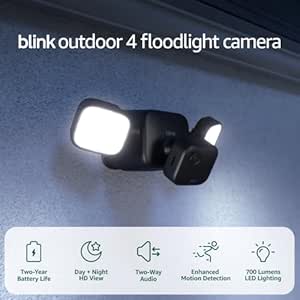
Blink Outdoor 4 Floodlight Camera
The Blink Outdoor 4 is the clear fit when adding wiring is impractical: it offers wire-free installation and a stated battery life of up to two years using AA lithium batteries. That flexibility is a major contrast with the hardwired Olafus and eufy E30, but it comes with less light and lower resolution. Blink’s 700-lumen floodlight and 1080p video are notably more modest than those cameras’ 2K video and brighter lights, and its infrared night vision differs from their color night vision. Two-way audio and app-based live view cover basic remote monitoring. Optional AI people detection and cloud storage require a paid subscription; local storage also needs an additional Sync Module XR and microSD card. I’d choose Blink for mounting flexibility and battery operation, not for broad, brightly lit coverage or included local recording.
Pros:- Wire-free installation avoids the hardwiring required by the Olafus and eufy E30
- Stated battery life is up to two years with AA lithium batteries
- Two-way audio and app-based live view support remote interaction
- Sync Module Core is included
Cons:- 700-lumen output is lower than the hardwired floodlight cameras in this lineup
- 1080p video and infrared night vision offer less detail and color than the 2K alternatives
- AI people detection and cloud storage require a paid subscription; local storage needs additional hardware
Best for: Renters or homeowners who need a camera in a location without convenient wiring and are comfortable with battery-powered monitoring.
Not ideal for: Buyers who need high-resolution identification, color night vision, stronger floodlights, or local recording without extra hardware.
- Resolution:1080p HD
- Light output:700 lumens
- Night vision:Infrared
- Audio:Two-way audio
- Power:AA lithium batteries
- Battery life:Up to two years
- Included hub:Sync Module Core
- Storage:Cloud storage trial; local storage requires Sync Module XR and microSD card
Our verdict“Pick Blink if battery-powered placement is your priority and you can accept lower-resolution video, infrared night vision, and add-on storage features.”
Ring Floodlight Cam Wired Plus, Outdoor Home or Business Security with Motion-Activated 1080p HD Video and Floodlights, 2-Pack, White
The two-camera bundle makes this Ring a practical pick for covering separate approaches, such as a driveway and a back entrance, without mixing brands. Its 2000-lumen lights and remotely triggered 105dB siren give each camera a clear deterrence role, while customizable motion zones can help reduce alerts from parts of the scene you do not need monitored. Compared with the Blink Wired Floodlight Camera, Ring provides a second unit in the box, but Blink has brighter stated lighting at 2600 lumens. Both require hardwired installation and offer 1080p video, so this is not the choice for buyers seeking higher-resolution identification. Ring’s other tradeoff is that the full feature set relies on a paid Ring Protect subscription; buyers who want straightforward local recording may prefer the eufy E340, which supports microSD or HomeBase storage.
Pros:- Two cameras help cover separate exterior areas with one matching system.
- 2000-lumen motion-activated floodlights illuminate outdoor spaces.
- Built-in 105dB siren can be triggered remotely in the Ring app.
- Customizable motion zones help tailor alerts to the monitored area.
Cons:- Hardwired installation can be difficult where suitable wiring is not already present.
- Full feature set relies on a paid Ring Protect subscription.
- 1080p resolution offers less detail than the 2K-class options in this roundup.
Best for: Homeowners or small-business operators who already have outdoor wiring and want two matching cameras to cover separate exterior zones.
Not ideal for: Renters, buyers without existing hardwired camera locations, and anyone who wants the full feature set without a paid Ring Protect subscription.
- Video resolution:1080p HD
- Floodlight output:2000 lumens
- Siren:105 dB
- Power source:Hardwired
- Pack quantity:2
- Color:White
Our verdict“Choose this two-pack if you want matched, hardwired Ring coverage for two outdoor zones and are comfortable with its subscription-dependent features.”
eufy Security Floodlight Camera E340 with AC Cable Dual-Lens
The dual-lens design is the E340’s defining advantage: a wide-angle view watches the broader area while a telephoto lens can bring distant activity into sharper view, with up to 8× hybrid zoom. Its 360° pan-tilt coverage and AI person detection suit buyers who want one camera to watch a large yard rather than fixed views of separate spots. Unlike the hardwired Ring Floodlight Cam Wired Plus, this model uses a 20-foot AC cable and does not require a junction box, though a suitable outlet and cable route are still needed. It also supports 24/7 recording to microSD or HomeBase, giving it a local-storage path Ring does not specify here. The tradeoffs are that storage is not included and AI tracking limits resolution to 2K, so tracking can give up some of the dual-lens system’s highest detail.
Pros:- Dual 2K telephoto and 3K wide-angle lenses combine distant detail with broad coverage.
- Up to 8× hybrid zoom can help inspect activity farther from the camera.
- 360° pan-tilt coverage and AI person detection support active monitoring.
- Local recording is available through microSD or HomeBase.
Cons:- A microSD card or HomeBase is needed for local storage and is not specified as included.
- AI tracking limits video resolution to 2K.
- The 20-foot power cable still needs a practical outlet and protected route.
Best for: Homeowners with a large yard, a suitable outdoor outlet, and a preference for pan-tilt coverage, zoom, and local recording options.
Not ideal for: Buyers who need the sharpest resolution during AI tracking, have no practical route for the AC cable, or expect storage to be included.
- Model:T8425
- Resolution:Dual 2K telephoto / 3K wide-angle; max 2K with AI tracking
- Zoom:Up to 8× hybrid zoom
- Floodlight output:2000 lumens
- Siren:95 dB
- Power:Corded electric, 20 ft AC cable
- Wi-Fi:2.4 GHz and 5 GHz, dual-band Wi-Fi 6
- Local storage:microSD up to 128 GB
Our verdict“Pick the E340 if detailed zoom and movable coverage matter more than a fully self-contained installation or maximum resolution during AI tracking.”
Tapo 2K Outdoor Pan/Tilt Wireless Floodlight Security Camera, C615F KIT
The C615F KIT suits buyers who want a wire-free camera with pan-tilt coverage and do not need a floodlight to wash a large area in bright light. Its 800-lumen output is substantially lower than the 2000-lumen Ring Floodlight Cam Wired Plus or eufy E340, making this a better fit for a porch or smaller yard than a broad driveway. Solar charging and a stated battery life of up to 140 days can reduce routine charging, provided the panel gets enough direct sun. Tapo also lists subscription-free AI detection, which may appeal to buyers who want smart alerts without relying on a paid cloud plan. The 360° horizontal and 130° vertical movement helps cover more than a fixed camera, but microSD storage is sold separately and Wi-Fi is limited to 2.4 GHz.
Pros:- Solar charging can reduce manual battery maintenance in a sunny installation spot.
- 2K resolution and 360° horizontal pan provide detail and broad coverage.
- Subscription-free AI detection supports alerts without a paid plan.
- Up to 140 days of stated battery life can limit charging interruptions.
Cons:- 800-lumen lighting is less suited to large areas than the brighter Ring and eufy options.
- Solar charging works best with direct sunlight.
- microSD storage is sold separately, and connectivity is limited to 2.4 GHz Wi-Fi.
Best for: Homeowners monitoring a sunny porch, small yard, or driveway who want solar charging, 2K video, and AI detection without a subscription.
Not ideal for: Buyers who need powerful illumination across a large area, have a shaded camera location, or rely on a 5 GHz-only Wi-Fi network.
- Resolution:2K
- Floodlight output:800 lumens
- Pan/tilt range:360° horizontal, 130° vertical
- Battery life:Up to 140 days
- Solar charging:Yes
- Wi-Fi:2.4 GHz
- Storage:microSD up to 512 GB; card sold separately
Our verdict“Choose the Tapo for solar-powered pan-tilt monitoring in a sunny, smaller area, but look elsewhere if floodlight brightness is your priority.”
SZPOWER 2K Floodlight Camera, Hardwired Outdoor Security Camera with 3500LM Light
The SZPOWER’s 3500-lumen floodlight is the strongest stated output among these five picks, giving it an advantage when lighting coverage matters more than movable views or a two-camera bundle. Its 3000K warm light is intended to look more natural and less stark than the 5000K lighting on the Blink Wired Floodlight Camera. The camera records at 3MP (2K) and pairs smart PIR detection with a 110° field of view, while local microSD storage supports cards up to 256GB. Compared with the eufy E340, this model is fixed rather than pan-tilt, so placement and aiming matter more; in return, it offers higher stated light output than the E340’s 2000 lumens. It requires hardwiring, and neither a microSD card nor cloud storage is included as a no-cost recording solution.
Pros:- 3500-lumen, 3000K lighting offers strong illumination with a warmer color tone.
- 3MP (2K) video and a 110° field of view cover a fixed outdoor scene.
- PIR motion detection is designed to reduce alerts from irrelevant movement.
- Supports local microSD recording up to 256GB and dual-band Wi-Fi.
Cons:- Hardwired installation limits placement flexibility and may require electrical work.
- The fixed view cannot pan or tilt to follow activity like the eufy E340 or Tapo C615F.
- microSD card is not included, and cloud storage is an optional paid feature.
Best for: Homeowners with outdoor wiring who want strong, warm floodlighting, a fixed camera view, and the option to record locally.
Not ideal for: Renters, buyers who need a battery or plug-in installation, or anyone seeking pan-tilt coverage to follow activity across a wide area.
- Resolution:3MP (2K)
- Light output:3500 lumens
- Color temperature:3000K
- Connectivity:2.4 GHz and 5 GHz Wi-Fi
- Power source:Hardwired
- Storage:microSD up to 256GB or cloud
- Weather range:-35°F to 115°F
- Field of view:110°
- Material:Aluminum
Our verdict“Choose the SZPOWER if bright, warm lighting and hardwired local-recording options matter more than pan-tilt coverage or a simpler installation.”
Blink Wired Floodlight Camera, 1080p HD, 2600 Lumens, White
The Blink Wired Floodlight Camera is a straightforward fit for buyers who want 1080p video, two-way audio, and a 105dB siren in an Alexa-compatible hardwired unit. Its 2600-lumen lights are brighter on paper than the 2000-lumen Ring Floodlight Cam Wired Plus, although Ring’s two-pack is the stronger choice when two locations need cameras. Blink’s 143° diagonal field of view gives it a broad fixed scene, but it cannot pan and tilt like the eufy E340 or Tapo C615F. Installation requires outdoor wiring and a neutral wire, so this is not a flexible choice for renters. Recording is another limitation: cloud storage and person detection require a subscription, while local backup needs separately sold accessories. Choose it for its simple feature mix, not for high-resolution footage or included local storage.
Pros:- 2600-lumen lighting is brighter on paper than the Ring Wired Plus and eufy E340.
- 143° diagonal field of view captures a broad fixed scene.
- Two-way audio and a built-in 105dB siren add communication and deterrence.
- Works with Alexa and provides color night view.
Cons:- Requires hardwired power and a neutral wire.
- Cloud storage and person detection require a subscription.
- Local backup requires separately sold accessories, and video resolution is 1080p.
Best for: Alexa households with an existing neutral-wire outdoor connection that want bright fixed-view lighting, two-way audio, and a built-in siren.
Not ideal for: Renters, buyers without a neutral wire, or shoppers who want 2K video, included local-storage accessories, or pan-tilt coverage.
- Camera resolution:1080p HD
- Field of view:143° diagonal
- Lighting:2600 lumens, 5000K
- Siren:105 dB, measured at 4 inches
- Power:Hardwired; neutral wire required; 100–240 VAC, 50/60 Hz, 45 W
- Wi-Fi:2.4 GHz 802.11b/g/n
- Audio:Two-way audio
- Dimensions:178 × 173 × 198 mm
- Compatibility:Alexa; all Blink Sync Modules
Our verdict“Pick Blink if you have the required wiring and want a bright, Alexa-compatible fixed-view camera; choose a pan-tilt or higher-resolution model for more flexible coverage.”
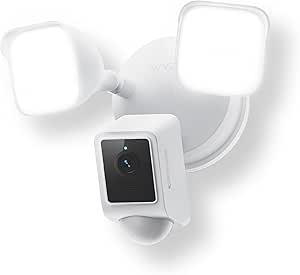
Wyze Floodlight Camera v2, 2K HD Outdoor Security Camera with 2800 Lumens
The Wyze Floodlight Camera v2 is a strong fit for buyers who want bright coverage and local recording without depending on a cloud plan for routine footage access. Its 2K video, color night vision, and 160° view give it a broader monitoring picture than the 1080p Blink Wired Floodlight Camera, while 2,800 lumens provide more stated light output than the Arlo Wired Floodlight’s 2,000 lumens. Motion-activated lighting, a 105dB siren, and two-way talk add deterrence beyond recording alone.
The main tradeoff is installation: this is a hardwired camera, and its outdoor power adapter is sold separately. It also connects only to 2.4GHz Wi-Fi, which may limit placement for homes that rely on 5GHz coverage. Choose it for microSD-based recording and strong illumination; skip it if you want a wireless setup or prefer cloud-focused features.
Pros:- 2K video with color night vision captures more detail than 1080p options such as the Blink Wired Floodlight Camera.
- 2,800-lumen motion-activated lights provide strong illumination for entrances and yards.
- 160° field of view helps cover a broad area with fewer blind spots.
- microSD storage supports local recording, with up to 30 days listed.
Cons:- Hardwired installation rules it out for many renters and locations without suitable power.
- Supports 2.4GHz Wi-Fi only, not 5GHz.
- Outdoor power adapter is sold separately.
Best for: Homeowners with an existing outdoor power connection who want bright lighting, wide coverage, and microSD recording without relying on a subscription for local footage.
Not ideal for: Renters or anyone without suitable wiring, and households whose camera network depends on 5GHz Wi-Fi.
- Video resolution:2K HD
- Light output:2,800 lumens
- Field of view:160°
- Motion detection:270° PIR
- Connectivity:2.4GHz Wi-Fi
- Storage:Local microSD, up to 30 days
- Weather resistance:IP65
- Audio and deterrence:Two-way talk and 105dB siren
- Power:Hardwired
Our verdict“Pick the Wyze if local microSD recording and 2,800-lumen lighting matter more than wireless installation or 5GHz Wi-Fi.”
Arlo Wired Floodlight Security Camera, 2K HDR, 1 Camera
The Arlo Wired Floodlight Camera suits buyers who want 2K HDR video and broad smart home compatibility in a permanently powered setup. It supports Amazon Alexa, Google Home, Apple Home, and Samsung SmartThings, a wider listed mix than the Wyze Floodlight Camera v2, which names Alexa, Google Assistant, and IFTTT. Its 12x zoom and color night vision give buyers more ways to inspect activity, while two-way audio and a siren add response options when motion is detected.
Its up to 2,000-lumen floodlight is less powerful on paper than Wyze’s 2,800-lumen pair, so buyers prioritizing maximum brightness may prefer Wyze. Arlo also ties cloud storage and advanced features to a paid plan after the trial. Installation requires hardwiring and a compatible 4-inch round weatherproof junction box; conflicting field-of-view figures in the product information add uncertainty when planning coverage.
Pros:- 2K HDR video and color night vision support detailed day and night monitoring.
- Compatibility spans Alexa, Google Home, Apple Home, and Samsung SmartThings.
- 12x zoom can help inspect activity within the camera’s view.
- Hardwired power avoids battery charging.
Cons:- Cloud storage and advanced features require a paid plan after the trial.
- Requires hardwiring and a compatible 4-inch round UL-listed weatherproof junction box.
- Product information lists conflicting field-of-view measurements, and the 2,000-lumen maximum is below Wyze’s 2,800 lumens.
Best for: Homeowners already using Apple Home, SmartThings, Alexa, or Google Home who have a compatible junction box and want hardwired 2K HDR monitoring.
Not ideal for: Buyers who want subscription-free cloud storage, the highest listed light output, or a clear field-of-view specification before purchase.
- Video resolution:2K HDR
- Floodlight brightness:Up to 2,000 lumens
- Field of view:Listed as 160° in specs and 130° in product description
- Night vision:Color
- Zoom:12x
- Power:Hardwired
- Connectivity:2.4GHz Wi-Fi
- Audio:Two-way audio and siren
- Smart home compatibility:Amazon Alexa, Google Home, Apple Home, Samsung SmartThings
Our verdict“Choose Arlo for broad smart home integration and 2K HDR if you accept subscription costs and can meet its junction-box installation requirements.”

How We Picked
I compared these cameras as outdoor security systems, not as lights or cameras in isolation. The main criteria were stated video resolution, field-of-view and tracking approach, light output, motion detection, power and installation requirements, weather protection where listed, and the practical burden of managing alerts and recordings. I also considered whether a model’s design suits one entrance, a wider yard, or more than one monitoring angle.
The order favors models with a strong balance of useful video, detection, lighting, and clear use cases, rather than ranking by a single headline specification. Ring Floodlight Cam 4K Plus earns the lead for its stated 4K video and 3D motion detection; the dual-lens eufy E340 and 2K Wyze v2 offer different routes to useful coverage and value. Models with more limited resolution or narrower use cases rank lower, though they may be a better fit for buyers who prioritize simpler setup, a two-camera package, or a particular ecosystem. Product features and service terms can change, so I treat listed specifications as comparison points rather than promises of identical results at every property.
Factors to Consider When Choosing Floodlight Security Camera
Choosing a floodlight camera is partly a camera decision and partly a site-planning decision. Before settling on a model, I’d match its power source, view, and recording setup to the place it will monitor; these choices can matter more day to day than a headline lumen or resolution figure.
Match the Camera View to the Area You Need to Watch
Start by deciding whether you need one fixed view or coverage of multiple directions. A single camera can work well for a doorway or driveway when its mounting angle captures the approach, but it may leave side paths or corners outside the frame. Pan-and-tilt or dual-lens designs can help cover broader areas, though movement and multiple views do not automatically produce more useful evidence. Check the camera’s stated field of view and where its lights sit relative to the lens. Avoid aiming directly at a street or a neighbor’s windows, both to limit unnecessary alerts and to respect privacy. If one camera cannot cover the key routes without blind spots, a second camera may be a better plan than relying on tracking alone.
Choose Resolution for the Distance You Need to Identify
Higher resolution can preserve more detail, but the benefit depends on how far away a person or vehicle will be and how the footage is stored. A 4K camera may be useful when identification detail matters across a larger view, while 2K or 1080p can be sufficient for a close entrance. Night footage, motion blur, camera placement, and compression can all limit the detail available in a recording. Do not assume that resolution by itself guarantees a readable face or license plate. Think through the likely distance and angle, then compare sample footage or camera specifications if available. Also check whether your home network can support the camera’s video demands without weakening reliability elsewhere.
Check Wiring Before You Compare Light Output
Many floodlight cameras need a wired connection, and hardwired models can require replacing an existing fixture or arranging electrical work. That can offer dependable power, but it narrows mounting choices and may add installation complexity. Battery-powered or kit-based designs can suit places without a convenient fixture, though you should confirm how their power setup affects lighting and recording behavior. Measure the mounting height and check that the camera can be aimed at the scene while the lights illuminate it. A powerful beam pointed away from the camera’s view may cause glare or leave the important area dim. Settle the installation plan before choosing based on lumens.
Treat Motion Detection as a Tuning Job
Motion detection must distinguish useful activity from passing cars, swaying branches, pets, and changing shadows. Features such as tracking or 3D motion zones can help direct attention, but no detection system removes the need to tune placement and alert settings. A camera aimed across a busy sidewalk may generate frequent notifications even if its detection features are sophisticated. Consider whether you can define activity zones and adjust sensitivity, then think about how quickly you want alerts to arrive. Spend time setting boundaries around public areas and recurring sources of false alerts. The best camera for a quiet side entrance may not be the best choice for a busy front yard.
Understand Recording, Storage, and Subscription Terms
Live viewing, motion alerts, recorded clips, and long-term playback may depend on different plans or storage options. Before buying, verify which features work without a paid subscription and whether local storage is supported by the specific model. Check how long clips remain available, what triggers recording, and whether access to advanced detection or video history carries an ongoing fee. A camera with attractive hardware can become a poor fit if its recording model does not match how you want to review events. Compare the complete system cost over the period you expect to keep it, not only the camera itself. Also confirm that the app and smart-home integrations you rely on support the exact model.
Balance Brightness Against Glare and Neighbor Impact
More lumens can illuminate a wider or darker area, but excessive brightness can wash out nearby objects or shine into neighboring windows. The beam pattern and the angle of the fixture matter as much as the listed output. For a narrow entry, adjustable positioning may be more useful than the highest lumen figure; for a broad yard, spread and light placement deserve more attention. Check whether the lights can be scheduled, dimmed, or triggered only by relevant motion. Consider local rules and household preferences around outdoor lighting, especially in close-set neighborhoods. A well-aimed, moderately bright fixture can provide more usable camera footage than a brighter one installed poorly.
Frequently Asked Questions
Is a 4K floodlight camera worth choosing over a 2K model?
Choose 4K when you need more potential detail across a broad view or expect to identify activity farther from the camera. That advantage can be reduced by poor lighting, motion blur, a distant mounting position, or video compression. A well-placed 2K camera may produce more useful footage at a close entry than a poorly aimed 4K unit. Check the recording and storage requirements too, since higher-resolution footage can place greater demands on a network or plan. For most buyers, the decision should follow the distance and scene they need to monitor rather than resolution alone.
Can I install a wired floodlight camera without an existing outdoor light?
Some wired models are designed to connect to household electrical wiring, so a nearby junction box may be needed even when no floodlight is already installed. Installation can involve electrical work and local code requirements, so check the product instructions and consult a qualified electrician if the wiring is unfamiliar. A battery or kit-based camera may be more suitable when the mounting location lacks power. Before ordering, confirm the power method, mounting hardware, and whether the lights operate as expected with that setup. Choosing around the site’s wiring can prevent an otherwise capable camera from being impractical.
Should I choose a dual-lens camera or a camera with one higher-resolution lens?
A dual-lens design is worth considering when you need to monitor separate areas or want different views from one installation point. A single higher-resolution lens may be the better fit when one clear, detailed view matters more than broader coverage. Compare how each camera presents its views in the app and whether both lenses record or track in the way you expect. Neither design removes blind spots caused by walls, rooflines, or poor positioning. Sketch the area and mark the approaches you need to see before deciding.
Do floodlight cameras record without a subscription?
That depends on the exact model and which recording features you want, so there is no reliable category-wide answer. Some cameras may provide live view or alerts while charging for saved clips, extended history, or advanced detection; others may offer local storage options. Read the current terms for the specific camera and confirm whether storage hardware is included or sold separately. Pay attention to clip length, retention time, and what happens if a plan ends. If avoiding recurring fees matters, make storage terms a requirement before comparing lighting or resolution.
What should I prioritize for a driveway: brightness, resolution, or motion coverage?
For a driveway, start with the camera’s view and the distance at which it needs to capture people or vehicles. Resolution matters when you want detail farther away, while motion coverage helps the camera detect activity across a wide or angled approach. Brightness can improve the scene after dark, but only if the beam reaches the area without causing glare. Mounting height and angle influence all three, so plan the position before settling on specifications. If the driveway is long or bends around a building, a second view may be more useful than maximizing one feature.
Conclusion
For the strongest balance of detailed video and motion features, I’d choose the Ring Floodlight Cam 4K Plus as best overall, provided its wired setup and service terms fit your needs. The Wyze Floodlight Camera v2 is my best-value pick for buyers seeking 2K video and substantial stated light output, while the Ring 4K Plus is also the best premium choice for those who put image detail first. Beginners who already use a familiar smart-home system may prefer the Blink Wired Floodlight Camera or the two-camera Ring Wired Plus package, depending on whether they need one location or two. For wider or split-angle coverage, look at the eufy E340 dual-lens camera; for less reliance on conventional wiring, compare the Blink Outdoor 4 Floodlight and Tapo C615F KIT setup details. Choose by installation fit, recording terms, and the view you need—not by brightness or resolution alone.
Evergreen bestsellers Picks

Bose QuietComfort Ultra Earbuds (2nd Gen), Wireless Noise-Cancelling Earbuds, Black

Dreame X60 Ultra Robot Vacuum and Mop with Dual AI Cameras

Bose QuietComfort Wireless Noise Cancelling Headphones – Twilight Blue Limited Edition
As an affiliate, we earn on qualifying purchases.