
TL;DR
In 2026, building your own AI workstation is no longer automatically cheaper. Prebuilts now often match or beat DIY prices thanks to bulk discounts, while offering validated thermals, support, and faster deployment. Your decision hinges on your need for control versus convenience.
Imagine this: you need a powerful AI workstation, ready to run complex models and handle intense workloads. You’ve always assumed building your own is the way to go—cheaper and customizable. But in 2026, that’s no longer a given.
The AI hardware market has shifted. Component prices have surged, and prebuilt systems now often come with validated thermals and support that can save you time, hassle, and even money. So, which route really makes sense for your AI projects? Let’s explore the real costs, benefits, and tradeoffs.
Build vs buy
an AI workstation.
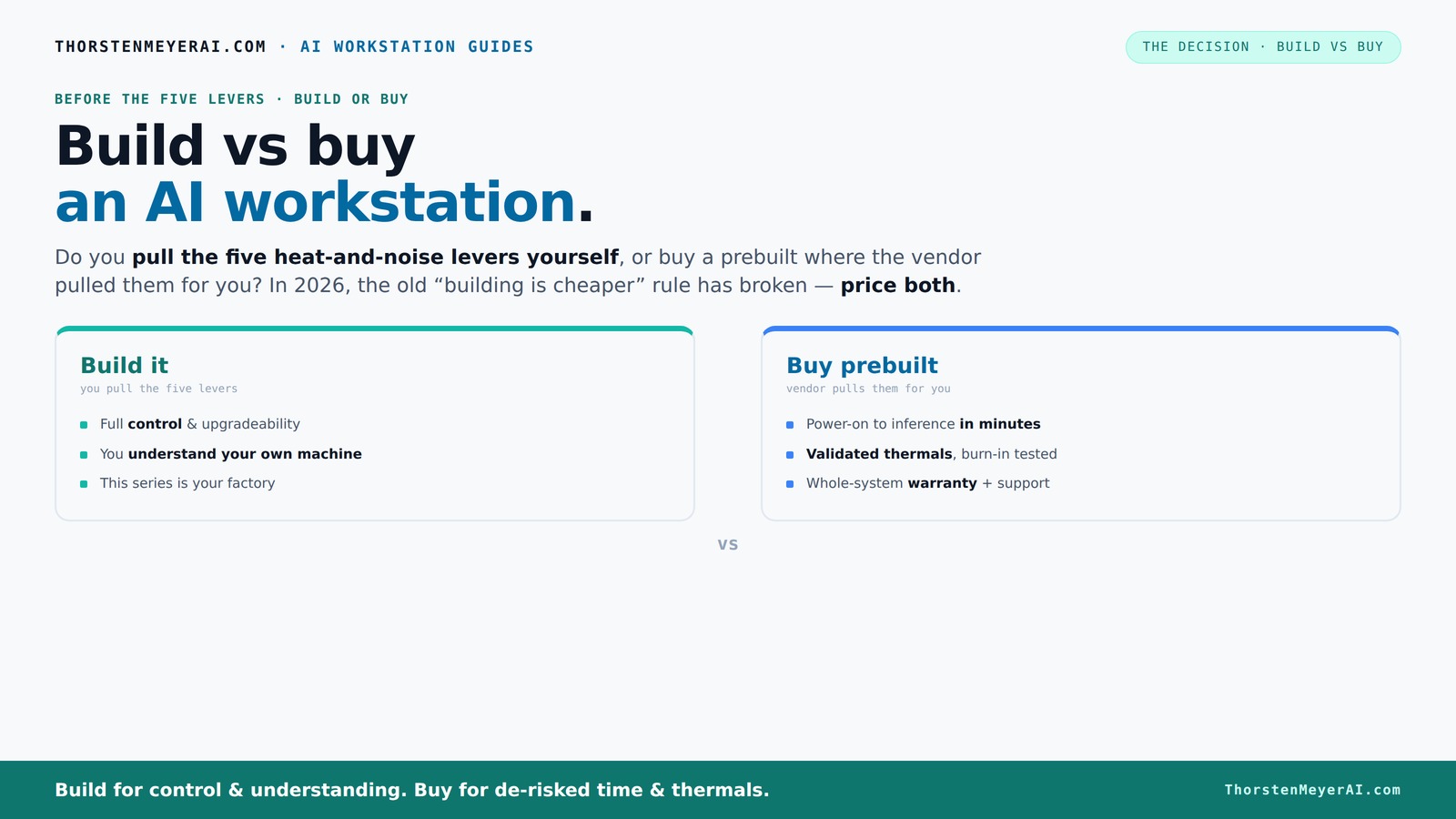
The real question behind this whole series: do you pull the five heat-and-noise levers yourself, or buy a prebuilt where the vendor pulled them for you? And in 2026, the old “building is cheaper” rule has broken. Match your situation in Part 3.
Key Takeaways
- Component shortages and bulk buying have made prebuilt AI workstations often as affordable as DIY in 2026.
- Prebuilts validate thermals, include support, and save time, making them ideal for those who prioritize reliability and speed.
- DIY builds offer maximum control and upgradeability but require time, expertise, and patience.
- The hot market now favors thoughtful price comparisons—don’t assume DIY is cheaper without checking the latest prices.
- Your choice should be based on workflow needs, budget, support preference, and how much you enjoy tinkering.
high performance AI workstation prebuilt
As an affiliate, we earn on qualifying purchases.
As an affiliate, we earn on qualifying purchases.
Why Building Your Own AI Workstation Isn’t Always Cheaper Anymore
Building your own AI system used to mean saving hundreds of dollars. Today, it’s a different story. Component shortages, inflation, and bulk discounts have pushed prices for GPUs, RAM, and SSDs higher. A build that used to cost around $1,000 now easily hits $1,250 or more, even before installing software.
For example, a mid-range GPU like the NVIDIA RTX 4090 has skyrocketed in price, making DIY more expensive than expected. Meanwhile, many prebuilt vendors have secured bulk deals, enabling them to offer systems at prices that are hard to match. According to recent market data, prebuilt systems with high-end GPUs often cost the same or less than piecing together parts individually.
So, the old rule—building is cheaper—no longer holds true automatically. You need to compare your specific specs and prices today. The decision now involves more than just cost; it’s about time, support, and future upgradeability.
Choosing between building and buying now requires understanding that the traditional cost savings of DIY are being offset by these market shifts, similar to considerations discussed on build vs buy a prebuilt AI workstation. The tradeoff becomes less about initial savings and more about factors like reliability, thermal management, and support. If you value a system that’s been tested for stability and offers warranty coverage, prebuilt options might actually be more economical in the long run, despite the higher sticker price.

CORSAIR Frame 4000D Vault Series Modular Mid-Tower ATX PC Case – High Airflow, InfiniRail Fan Mounting System, Modular Customization, Spacious Interior, GPU Anti-Sag – Galaxy
Limited Edition Vault Series - The FRAME 4000D enters the Vault. This inaugural release showcases the stunning Galaxy...
As an affiliate, we earn on qualifying purchases.
As an affiliate, we earn on qualifying purchases.
The Five Levers of a High-Performance AI Workstation — Who Pulls Them?
Running an AI workstation smoothly isn’t just about hardware specs. It’s about managing heat, noise, and stability under sustained loads. These are the five levers: undervolting the GPU, matching the right cooling system, optimizing case airflow, tuning fan curves, and positioning the machine for maximum thermal efficiency.
If you build it yourself, you get to pull these levers—tuning everything to your exact workflow, similar to build vs buy a prebuilt AI workstation. You select a quiet GPU, like those listed on this guide, undervolt it for efficiency, and set up custom cooling. It’s a hands-on process that requires some expertise but offers maximum control.
Buy a prebuilt, and the vendor pulls these levers for you. Companies like Lambda or Puget Systems validate thermals through extensive testing, ensuring your machine won’t throttle under load. They often include custom water cooling or advanced fans that run quietly even during intense AI training sessions, saving you hours of setup and troubleshooting, much like build vs buy a prebuilt AI workstation.
Understanding these levers reveals why thermals and noise are critical for AI workloads. Poor thermal management can cause throttling, reducing performance, while excessive noise can be distracting during long training runs. Prebuilts that focus on these aspects often provide a more optimized, reliable experience—crucial when training large models or running continuous workloads. The tradeoff is that DIY offers the opportunity to fine-tune these factors precisely, but it requires experience and time investment. So, your choice depends on whether you prioritize convenience and reliability or customization and control.
validated thermals AI desktop
As an affiliate, we earn on qualifying purchases.
As an affiliate, we earn on qualifying purchases.
Prebuilt vs Custom Build: When Should You Pick Each?
| Scenario | Prebuilt | Build It Yourself |
|---|---|---|
| You want fast, reliable setup with support | Yes. Systems come with validated thermals, warranty, and support. Just power on and go. | No. You’ll spend time sourcing parts, troubleshooting, and tuning. |
| Need exact control over components, upgrades, or workflow | No. Limited upgrade paths, especially with proprietary parts. | Yes. You choose every component, ensuring perfect fit for your needs. |
| Want to optimize for noise and thermals | Yes. Vendors often do extensive testing and custom tuning. | Yes, but requires expertise and time to tune your system. |
| Cost is a primary concern | Variable. Sometimes more expensive due to added support but often comparable or cheaper in 2026. | Typically cheaper on parts alone, but hidden costs like troubleshooting can add up. |
Choosing between prebuilt and DIY now involves understanding that prebuilt systems often incorporate advanced thermal management and testing, which can be costly to replicate at home. This means that while the initial price might seem higher, the total cost of ownership—including support, warranty, and peace of mind—can favor applianceslabs.com. Conversely, DIY offers the advantage of customizing each component for specific needs, which might be more cost-effective if you already have experience and time to invest. The key is to evaluate your priorities: if you value simplicity and guaranteed stability, prebuilts are compelling. If you enjoy tinkering and want maximum control, DIY remains a strong option, but always compare the total costs and potential hidden expenses.

HP OMEN 45L Gaming 5090 Desktop PC, Intel Core Ultra 9 285K, GeForce RTX 5090, 128GB DDR5, 4TB SSD, Support 4-Display 4K, Light Studio, HDMI, DP, Wi-Fi 6E, Windows 11 Pro, AI-Ready Workstation Desktop
【High Speed RAM And Enormous Space】128GB DDR5 RAM to smoothly run multiple applications and browser tabs all at...
As an affiliate, we earn on qualifying purchases.
As an affiliate, we earn on qualifying purchases.
Real-World Examples: When Prebuilt Wins and When DIY Shines
Take Alice, a data scientist who needed a system fast. She ordered a prebuilt from Lambda, and within a week, her system was running her large language models with no fuss. The vendor handled the thermal tuning, and support was just a call away. For Alice, the time saved and support made the extra cost worthwhile.
Then there’s Bob, a hobbyist who loves tinkering. He built his own AI workstation, carefully selecting a quiet GPU and custom cooling. He enjoys tweaking the fans, undervolting, and learning as he goes, similar to the approach discussed in build vs buy a prebuilt AI workstation. His system runs smoothly, and he saved money on parts—plus, he gained valuable skills.
Both scenarios highlight that prebuilt often suits those who prioritize time and support, while DIY app, similar to woodworkslibrary.com.eals to those who crave control and enjoy the process. The tradeoff is that prebuilt systems tend to be more tested and optimized for stability, which can be critical for long, intensive training sessions. DIY builds, however, allow for more experimentation and customization, potentially squeezing out extra performance or efficiency if you know what you're doing. Your choice depends on whether you prefer reliability and speed or flexibility and learning.
How to Decide: Your Perfect AI Workstation Strategy in 2026
Here’s a simple step-by-step to help you choose:
- Assess your workflow. Do you need ultra-custom setups or just reliable performance?
- Compare prices today. Use tools like Amazon for parts and check vendor quotes.
- Factor in support and warranty needs. Are you comfortable troubleshooting or do you want a support plan?
- Consider future upgrades. Do you want a system that’s easy to open and modify?
- Balance your time against your budget. If time is tight, prebuilts often win.
Remember, in 2026, the best choice depends on your specific needs, not just the sticker price. The decision involves weighing the value of support, reliability, and customization against the time and effort you’re willing to invest. Carefully analyzing these factors will help you select a solution that not only fits your current needs but also scales with your future AI ambitions.
Frequently Asked Questions
Is it cheaper to build or buy an AI workstation today?
In 2026, component shortages and bulk buying have made prebuilt systems often as or more affordable than DIY builds. Always compare specific prices for your desired specs to decide.
What specs matter most for AI workloads: GPU, VRAM, RAM, or CPU?
GPU and VRAM are king—look for at least 24GB of VRAM for large models. RAM should be 64GB or more for training, and a high-end CPU supports data handling. Focus on the GPU class and thermal headroom.
Do prebuilts have enough cooling for long AI training sessions?
Yes, top vendors validate thermals and often include custom water cooling or optimized airflow. They run extensive burn-in tests to prevent throttling during long workloads.
Are prebuilt AI workstations easier to upgrade later?
Generally, yes, but some OEMs use proprietary parts. Check the upgrade paths before buying—DIY builds always allow more straightforward upgrades.
What hidden costs should I watch for with DIY builds?
Expect to spend extra time troubleshooting, tuning, and possibly replacing parts. Also, factor in the cost of support and warranty if something goes wrong.
Conclusion
In a world where hardware costs shift quickly and support can make or break your project, your best bet depends on your style and needs. If you want a ready-to-run system with support, prebuilts are hard to beat. But if you enjoy the craft and crave control, building your own can still pay off—just check prices first.
In 2026, the smartest move is to weigh your priorities carefully. Don’t just follow instinct—do the math, compare options, and choose what makes your AI journey smoother and more satisfying. Your perfect workstation is waiting.