
Acoustic Dampening, Placement, and the "Rig in the Closet" Setup

TL;DR

Moving your rig into a closet can dramatically cut noise and improve sound quality. Proper dampening, placement, and ventilation are key to making it work without overheating or echo. A little DIY can go a long way.

Ever wondered how to get studio-quality sound from a tiny closet? The secret isn’t just foam panels or thick blankets; it’s about smart placement, proper dampening, and good airflow. Moving your rig into a closet can be a game-changer—quiet, private, and budget-friendly. You can learn more about home improvement and smart home solutions to optimize your space. But without planning, it can turn into a hot, echoey mess. This guide breaks down the best ways to turn a cramped space into a sound sanctuary, all while keeping your gear cool and your workflow smooth.
Acoustic Dampening & Placement — Interactive Infographic
ThorstenMeyerAI.com · AI Workstation Guides
Lever 5 of 5 · Placement · Interactive
The last lever · move it out

Acoustic dampening
& the rig in the closet.

The most powerful noise fix isn’t a material — it’s a floor plan. A rig you can’t hear because it’s in another room beats any amount of foam. Tap the approaches in Part 1 to see what actually works.

1 The hierarchy people get backwards
Distance beats foam — by a lot
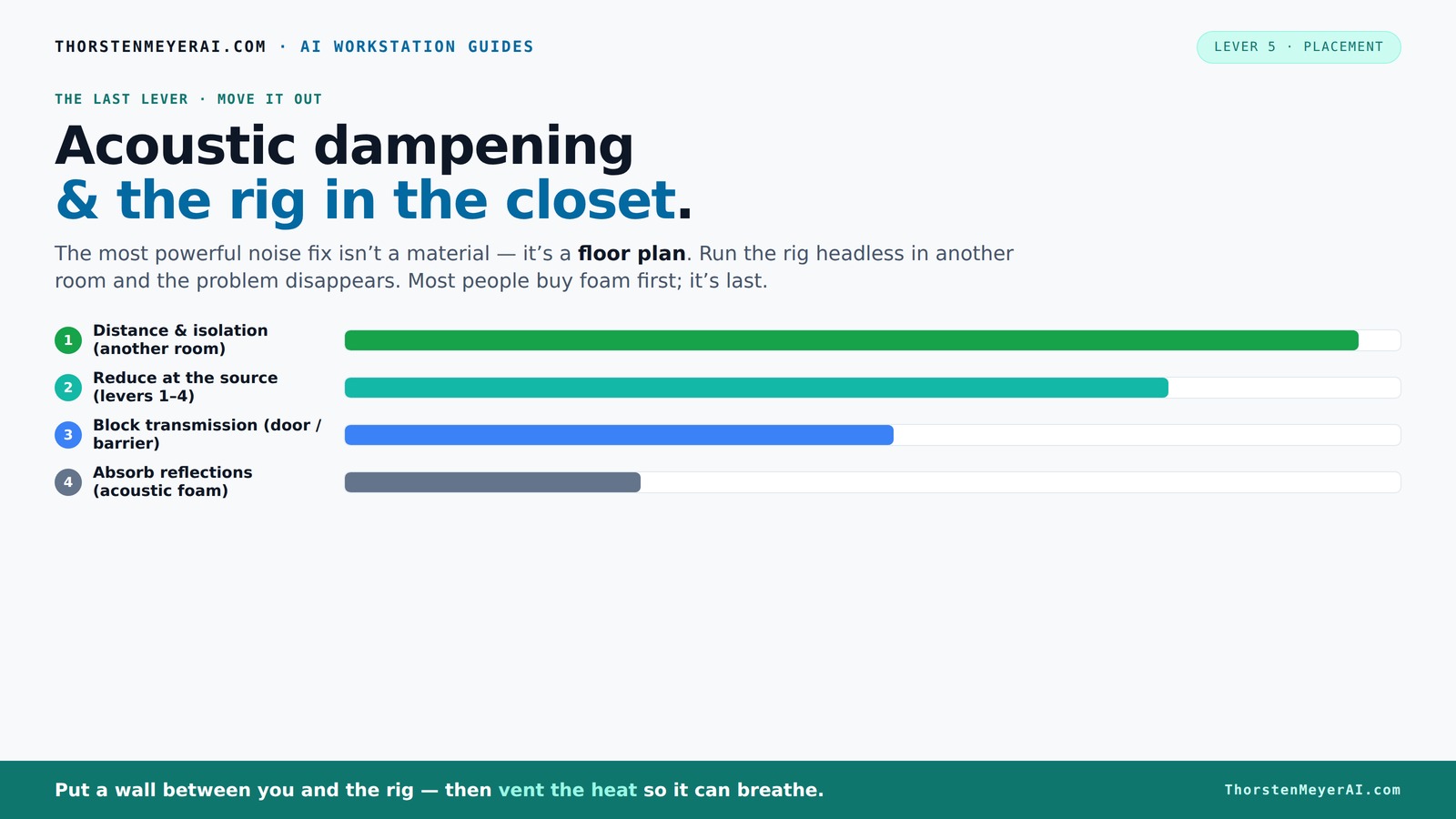
Acoustic treatment has a clear order of effectiveness. Most people buy foam first — it’s last. Tap a row for why.
1Distance & isolation
(another room)
most
2Reduce at the source
(levers 1–4)
high
3Block transmission
(door / barrier)
medium
4Absorb reflections
(acoustic foam)
least
#1 · Distance & isolationThe best soundproofing is a wall. Move the rig to another room and run it headless — the noise problem disappears instead of being mitigated.
2 Two kinds of noise, two fixes
Foam and pads solve different problems
Pick the wrong fix and you treat noise that was never going to respond to it.
Airborne
The whoosh of fans, the GPU hum — traveling through air.
Foam absorbs it (less echo in the room)
A barrier blocks it (stops it leaving)
×Foam alone won’t stop it passing through a wall
Structure-borne
The low hum the machine sends into the desk, floor & walls.
Anti-vibration pads / rubber feet decouple it
Soft-mount drives, or use silent SSDs
×Foam does nothing for this — it’s mechanical
3 The rig in the closet
Great noise fix — with one catch
Enclosing a hot rig works beautifully for noise. But a sealed space traps heat — the same trap as a sealed case, scaled to a room.
GPU rig cool in hot out (fan) it must breathe

Contain the noise, not the heat

Vent it — a passive path, or a quiet exhaust fan pulling hot air out.
Soundproof cabinets do both: foam lining + thermostat-controlled exhaust.
An AIO helps here — it exports CPU heat out a radiator.
⚠ Never fully seal a 24/7 rig. Trapped 600W+ of heat = the GPU breathing its own exhaust = throttling & roaring fans.
4 The few products worth it
Mostly free technique — a handful of items help
Anti-vibration pads
Best value here. Kills structure-borne hum for a few dollars.
Soundproof server cabinet
The engineered quiet + cool answer, with built-in exhaust.
Acoustic foam panels
Tames reflections in the room — not for blocking transmission.
Quiet exhaust fan
Ventilates a closet or cabinet so the heat can leave.
5 The numbers
What containment can buy
Counts animate to typical figures.
Soundproof cabinet cuts
~36%
of perceived noise — while still dissipating kilowatts.
Serious enclosures reach
30 dB
of reduction — up to 5× quieter than an open rack.
A wall between you & it
100%
of the problem, gone — the cheapest fix there is.
Acoustic principles from server-room and quiet-PC soundproofing references; cabinet figures from manufacturer specs (StarTech, SysRacks, UCoustic). Figures vary by enclosure and environment. Affiliate disclosure on page.
ThorstenMeyerAI.com

Key Takeaways

  • Moving your rig into a different room or closet can cut noise and heat dramatically, often more than foam treatments.
  • Separate soundproofing (blocking noise) from acoustic treatment (improving sound inside). Both are vital but serve different purposes.
  • Ventilation is critical—sealed spaces trap heat and can damage your equipment, so include active airflow solutions.
  • Placement of absorptive materials at reflection points makes a huge difference in sound clarity and boxiness.
  • Start simple with blankets and rugs, then upgrade to panels and bass traps for a professional sound.
Focusound 52 Pack Acoustic Foam Panels 1" x 12" x 12" Sound Proof Foam Panles Soundproofing Noise Cancelling Wedge Panels for Home Office Recoding Studio with 300PCS Double-Side Adhesive

Focusound 52 Pack Acoustic Foam Panels 1" x 12" x 12" Sound Proof Foam Panles Soundproofing Noise Cancelling Wedge Panels for Home Office Recoding Studio with 300PCS Double-Side Adhesive

Soundproofing - Acoustic foam panels triangular grooves structure for better noise absorption, helps to reduce and absorb unwanted...

As an affiliate, we earn on qualifying purchases.

As an affiliate, we earn on qualifying purchases.

Why Your Closet Can Be Both a Blessing and a Curse for Sound

Closets are small, enclosed, and easy to treat. They’re perfect for isolating noise and reducing echo. Imagine speaking inside a cardboard box versus an open room — the box traps your voice, making it sound more focused and less echoey. Similarly, a closet can contain and control sound reflections, giving you a clearer recording or mix. However, this same enclosure traps heat and humidity, like a thermos bottle, which can cause your equipment to overheat if not managed properly. Plus, if you don’t add the right materials, sound can bounce around and create a muffled, boxy sound—similar to talking inside a bathroom stall. The trick is recognizing that a closet can be a great tool if you treat it properly—adding sound-absorbing materials at reflection points and ensuring good airflow, much like acoustic dampening and proper placement. This way, you get the benefits of isolation without sacrificing comfort or gear safety.

HomeProtect Door Draft Stopper 36 Inch Under Door Draft Blocker Door Sweep for Bottom of Door Reduce Cold Air, Soundproof, Light, Odor, Weather Stripping Door Seal Strip Fit for Interior/Exterior

HomeProtect Door Draft Stopper 36 Inch Under Door Draft Blocker Door Sweep for Bottom of Door Reduce Cold Air, Soundproof, Light, Odor, Weather Stripping Door Seal Strip Fit for Interior/Exterior

[Affordable]Single-side door draft stoppers are generally less expensive than double door draft stoppers. Our door draft stopper is...

As an affiliate, we earn on qualifying purchases.

As an affiliate, we earn on qualifying purchases.

The Difference Between Soundproofing and Acoustic Treatment (And Why It Matters)

Think of soundproofing as installing a thick, noise-canceling jacket around your room—like sealing all the gaps in a window frame or adding mass to the walls, so sound doesn’t escape or enter easily. For example, adding an extra layer of drywall or sealing gaps around the door is like putting on a winter coat—blocking outside noise from sneaking in or your sound from leaking out. Acoustic treatment, on the other hand, is like placing soft pillows and curtains inside the room to make the sound inside more pleasant—by absorbing echoes and reducing harsh reflections. Imagine recording vocals in a small closet: without proper treatment, your voice might bounce off the walls like a pinball, creating a harsh, echoey sound. Adding foam panels at reflection points is like placing cushions where sound bounces—making your recordings clearer. On the flip side, if your room isn’t soundproofed well, loud neighbors or street noise can still leak in, no matter how many panels you put up. Balancing both—sealing gaps and adding absorption—ensures your space is quiet and sounds natural, like recording in a professional studio.

Sound Addicted - Studio Monitor Isolation Pads suitable for 6.5, 7 and 8 Inches Large Speakers | Reduce Vibrations and Fits most Stands - Pair | SMPad 8

Sound Addicted - Studio Monitor Isolation Pads suitable for 6.5, 7 and 8 Inches Large Speakers | Reduce Vibrations and Fits most Stands - Pair | SMPad 8

SMPad 8 is made out of the highest quality acoustical foam (50kg/m^3 density).

As an affiliate, we earn on qualifying purchases.

As an affiliate, we earn on qualifying purchases.

Where to Place Acoustic Panels for the Best Sound Inside Your Closet

Imagine standing inside a small, echoey bathroom. To improve sound, you’d hang a towel on the wall or place a rug on the floor to absorb the sound waves bouncing around. For more tips on acoustic treatment. Similarly, in your closet, placing acoustic panels at the first points where sound hits the walls—like the side walls at ear or mic height—is crucial. For example, if you’re recording vocals, position panels directly behind your microphone to prevent sound from bouncing back and causing phase issues, much like placing a cushion behind a speaker to absorb rear reflections. Ceiling panels are like acoustic tiles in a concert hall—they help reduce flutter echo, which sounds like a ringing or squeaking—imagine clapping in a long, empty corridor. Bass traps in the corners are like placing heavy blankets in the corners of a room—you’re targeting low frequencies that tend to linger and cause boomy sounds, similar to how a thick curtain can muffle bass sounds. Covering about 20-40% of reflective surfaces—like hanging a few thick blankets on the walls—strikes a balance between controlling echo and maintaining some natural liveliness. You might find useful more advice on acoustic treatment. Over-treating is like putting too many cushions in a room, making it sound dead and unnatural, like a soundproof booth. The goal is to find that sweet spot where reflections are controlled but the room still feels natural, much like tuning a guitar string for the right sound.

8" Room to Room Air Transfer Fan for Quietly Circulating Air, Reversible Airflow Design, 320 CFM Programmable Through Wall Fan, Durable Build Quality, 10 Speed Thru Wall Exhaust Fan for Closet,Laundry

8" Room to Room Air Transfer Fan for Quietly Circulating Air, Reversible Airflow Design, 320 CFM Programmable Through Wall Fan, Durable Build Quality, 10 Speed Thru Wall Exhaust Fan for Closet,Laundry

【QUIET, MOVE MASSIVE AIR】 This room to room fan quietly circulates air between two rooms to maintain a...

As an affiliate, we earn on qualifying purchases.

As an affiliate, we earn on qualifying purchases.

Frequently Asked Questions

What is the difference between soundproofing and acoustic dampening?

Soundproofing blocks sound from leaving or entering a space—think sealing gaps or adding mass. Acoustic dampening improves how sound behaves inside a space by reducing echo and reflections—think panels or foam that absorb sound waves.

Where should I place acoustic panels in a closet studio?

Place panels at the first points of reflection—side walls at ear or mic height—and behind the mic. Corners benefit from bass traps. Think of it as hanging a blanket on the wall or placing cushions where sound bounces—this stops reflections and creates a clearer sound, much like placing soft furniture in a room to absorb noise. For example, if you’re recording vocals, position panels directly behind your microphone to prevent sound from bouncing back and causing phase issues, much like placing a cushion behind a speaker to absorb rear reflections.

Do I need bass traps or are panels enough?

In small closets, foam panels help with mid and high frequencies, but bass traps are essential for controlling low-end buildup, especially in corners. Learn more about proper acoustic treatment. Think of bass traps as heavy blankets in the corners of a room—these are designed to absorb the low frequencies that tend to linger and cause a boomy sound, much like muffling the bass of a guitar amplifier with a soft cloth. Combining both gives a balanced, clear sound, similar to tuning a musical instrument for optimal tone.

How much of the closet should I treat?

Treat roughly 20-40% of the surfaces—walls, ceiling, and corners—focusing on reflection points. Over-treating can deaden the sound, like filling a room with too many pillows, making it sound unnatural or overly dull. Think of it like seasoning a dish—adding just enough enhances the flavor without overpowering it. Adjust your treatment based on your specific space and needs to find that perfect balance where the room sounds natural yet controlled.

Can I use blankets or rugs instead of studio panels?

Yes, thick blankets, rugs, or moving blankets work well as sound dampening materials.IY absorption—similar to hanging thick towels or quilts on the walls of a bathroom to reduce echo. They’re cost-effective and easy to reposition, much like placing a throw over furniture to dampen sound. This makes them ideal for initial setups or budget-conscious projects, giving you a quick way to improve sound quality without investing in professional panels.

Conclusion

Turning a closet into a quiet, well-treated studio is less about fancy gear and more about strategic placement, effective dampening, and smart ventilation. It’s a budget-friendly way to get studio-quality sound without sacrificing your living space. Think of it as sculpting your environment—making noise work for you, not against you.
You May Also Like

Micro‑Workouts: Staying Fit With Five‑Minute Exercise Burstsbusiness

Discover how five-minute micro-workouts can boost your energy and productivity during busy workdays, revealing simple ways to stay fit while working.

Indoor Cycling Setup: Bike Fit Basics for Knees and Back

The essential indoor cycling setup tips for preventing knee and back strain will help you ride comfortably—discover how to optimize your bike fit now.

Portable AC Basics: Dual-Hose vs Single-Hose and Why It Matters

Meta description: “Many wonder whether dual-hose or single-hose portable ACs are better—discover the crucial differences that could impact your comfort and energy savings.

DIY Natural Cleaners That Actually Disinfect (Backed by Research)Business

Create effective DIY natural cleaners backed by research that can truly disinfect—discover the science behind safe, eco-friendly solutions for your home.