

This checklist is for remote newsroom staff building a comfortable workstation for reporting, editing, and other desk-based work. It covers the named picks for seating, desk height, monitor positioning, input devices, connectivity, and power.

Get everyday essentials delivered free with Prime
- Fast, free delivery on millions of items
- Prime Video, Amazon Music and more included
- Member-only deals all year
The sections follow the path from workstation setup to everyday use: chair and desk first, then display and controls, followed by the dock and power strip. Each section explains the role of that slot and what details to check before choosing the listed product.
Use the look-for lists to compare the product name with your workspace and equipment. Check measurements, mounting requirements, connections, and included components against your own setup; the names alone do not confirm every fit or compatibility detail.
Ergonomic Office Chair
A chair is a central part of a desk-based workstation, especially when reporting or editing keeps you seated for long stretches. The listed pick is the ELABEST X100 Ergonomic Mesh Office Chair with Footrest. Before choosing it, check the chair’s dimensions against your desk area and the route it must take through doorways or around furniture. Make sure there is room to move the chair and use its footrest without hitting nearby objects.
A common buying mistake is assuming that a product labeled ergonomic will fit every body or desk. Review the available sizing and adjustment details, and compare them with your preferred seated position. Check the seat height against your desk and confirm that the chair can tuck in as needed. If you share the workstation, consider whether its adjustments can accommodate each person. Confirm what the product listing says about assembly and included parts, and treat the footrest as a feature to evaluate rather than a guarantee that the chair suits your posture.
What to look for:
- Chair dimensions and clearance around the desk
- Seat-height range relative to your desk
- Adjustment details that suit your seated position
- Footrest placement and room to extend it
- Assembly requirements and included components
ELABEST X100 Ergonomic Mesh Office Chair with Footrest

The ELABEST X100 is a premium ergonomic office chair featuring a dynamic 3D lumbar support system, flip‑up 5D armrests and an extendable footrest for work or gaming. Its dual‑stripe AirMesh back offers superior breathability while the 17‑point micro‑adjustment system promotes active spinal alignment for long‑hour comfort.
Pros:
- Dynamic 3D lumbar and spine alignment system reduces fatigue during long sessions
- Flip‑up 5D armrests and extendable footrest provide versatile positioning for work or gaming
- Ventilated dual‑stripe AirMesh back improves airflow and comfort
Cons:
- Assembly, while tool‑free, may still take up to 15 minutes for some users
Best for: People looking for a mesh office chair with a footrest
Not ideal for: Workspaces without room for a footrest or chair movement
Bottom line: Check the dimensions and adjustment details against your desk and preferred seated position before selecting the ELABEST X100.
Adjustable Standing Desk
A desk converter can change how a workstation is arranged without replacing the existing desk. The listed VIVO Dual-Tier Standing Desk Converter, 42-Inch, Black identifies a dual-tier layout and a 42-inch width, so start by measuring the desk surface and confirming that the converter’s footprint leaves room for other essentials. Check the product listing for its height range and adjustment method to see whether it can reach a comfortable working position in your room.
A frequent mistake is judging fit by width alone. Measure the usable depth of the desk, account for the converter’s base, and check whether your display and keyboard can occupy the intended tiers. Compare the available adjustment range with the heights you need while seated and standing, and verify any listed capacity against the equipment you plan to place on it. If the desk is against a wall or beneath shelves, check clearance throughout the converter’s movement. The product name does not establish the surface dimensions, load limit, or adjustment details, so confirm those in the listing before deciding.
What to look for:
- Converter footprint against the desk’s usable surface
- Surface depth and room for display and keyboard
- Height range for seated and standing positions
- Listed load limit for planned equipment
- Clearance from walls, shelves, and nearby objects
VIVO Dual-Tier Standing Desk Converter, 42-Inch, Black

This adjustable standing desk converter has a 42 x 22-inch work surface and a removable keyboard tray that rises with the desktop. Dual pneumatic springs and a touch height-locking mechanism support adjustments from 6 to 17 inches; the desktop holds up to 33 lbs and the keyboard tray up to 4 lbs.
Pros:
- Large work surface accommodates single or dual monitor setups
- Keyboard tray moves in sync with the desktop
- Smooth pneumatic lift with adjustable height locking
- Minimal assembly required
Cons:
- Limited weight capacity on the keyboard tray
- Requires an existing desk for placement
Best for: Workstations seeking a dual-tier converter with a 42-inch width
Not ideal for: Desks without enough surface area or overhead clearance
Bottom line: Measure the desk and verify the converter’s surface dimensions, height range, and capacity before choosing this VIVO model.
Ultrawide Computer Monitor
Monitor positioning matters when a newsroom workstation uses a large or curved display. The listed Ultrawide Monitor Arm – Fits 17‑49 in, Heavy-Duty Flat/Curved Monitor names a supported size range and says it is intended for flat or curved monitors. Confirm that your display falls within the stated range, then check its weight and mounting pattern against the arm’s specifications. The fit label alone does not confirm that a specific monitor is supported.
A common mistake is checking screen size but overlooking mount compatibility. Read the monitor and arm specifications together: compare weight, mounting standard, and any limits for curved displays. Check how the arm attaches to the desk, including the required edge clearance and desktop thickness, and make sure that mounting method suits your desk material and layout. Consider how far the screen needs to move and whether the arm’s reach and range of motion accommodate your preferred position. Leave enough space for cables to move without snagging when the display is repositioned. Verify all specifications in the product listing before purchasing.
What to look for:
- Monitor size within the stated 17–49-inch range
- Display weight within the arm’s listed capacity
- Matching mounting pattern and hardware
- Desk thickness and edge clearance for attachment
- Arm reach, movement range, and cable clearance
Ultrawide Monitor Arm – Fits 17‑49 in, Heavy‑Duty Flat/Curved Monitor
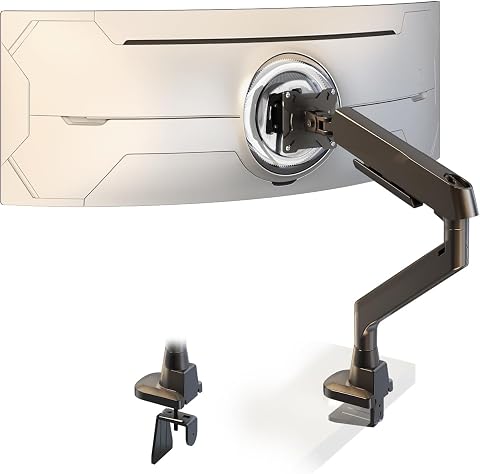
The STANDOPIA ultrawide monitor arm supports flat and curved screens from 17 to 49 inches and up to 35.2 lb with a high‑quality gas spring that eliminates sag. It offers full motion—including tilt, swivel, and 360° rotation—and integrated cable management for a clean, ergonomic workspace.
Pros:
- Supports a wide range of monitor sizes (17‑49 in) and weights up to 35.2 lb.
- Full motion adjustment with smooth tilt, swivel, and 360° rotation.
- Integrated cable management keeps the workspace tidy.
- Heavy‑duty clamp fits desks 10–50 mm thick for secure installation.
Cons:
- May be heavy to adjust frequently due to robust construction.
Best for: People checking an arm option for a 17–49-inch flat or curved monitor
Not ideal for: Displays or desks that fall outside the arm’s listed specifications
Bottom line: Match the monitor’s size, weight, and mounting pattern to the arm and confirm the desk attachment requirements.
Mechanical Keyboard
Keyboard and mouse are the daily contact points for drafting, editing, and navigating a newsroom workstation. The listed Logitech MX Keys S Combo Wireless Keyboard and Mouse, Graphite is named as a combo, so confirm which devices and accessories the package includes. The product name does not specify switch type or keyboard layout; review the listing for those details and compare them with your typing preferences and the layouts you use for work.
A common mistake is choosing a combo by appearance or assumed features without checking how it connects to your computer. Verify the connection options and supported operating systems for the devices you intend to use, including any newsroom laptop or desktop. Check the keyboard’s dimensions against available desk space and whether the mouse suits your preferred hand and grip. If you switch between multiple computers, confirm that the listed device-switching support meets your needs rather than inferring it from the product family. Review charging or battery details and included cables or receivers so the combo fits your everyday workflow.
What to look for:
- Keyboard layout and dimensions
- Connection options and operating-system support
- Mouse shape and fit for your hand
- Multi-device features confirmed in the listing
- Power, charging, and included accessories
Logitech MX Keys S Combo Wireless Keyboard and Mouse, Graphite

This wireless combo pairs the MX Keys S keyboard, with laptop-style spherically dished keys and adaptive backlighting, with the MX Master 3S mouse, featuring an 8K DPI sensor and MagSpeed scrolling. Both devices are rechargeable, support pairing with up to three devices, and work across multiple operating systems.
Pros:
- Laptop-style keys are shaped for fingertips and provide adaptive backlighting.
- Mouse offers MagSpeed scrolling and an 8K DPI sensor that tracks on glass at least 4 mm thick.
- Both devices are rechargeable and support pairing with up to three devices.
- Includes post-consumer recycled plastic in both devices.
Cons:
- The combo is not compatible with other Logitech USB receivers.
- Logi Options+ customization requires Windows or macOS.
- Bluetooth may prevent password entry at startup or reboot on some macOS computers with FileVault enabled; the included receiver is suggested as a workaround.
Best for: People seeking a named wireless keyboard and mouse combo
Not ideal for: Anyone requiring a specific layout or connection not confirmed in the listing
Bottom line: Check the layout, connection support, and included components against the computers used at your workstation.
USB-C Docking Station
A dock can help consolidate connections at a workstation, but the listed Anker Prime 14-in-1 Thunderbolt 5 Docking Station should be matched carefully to the computer and peripherals. Confirm that the computer supports the dock’s connection standard and that the dock’s ports cover the devices you plan to attach. The product name identifies it as a 14-in-1 Thunderbolt 5 dock, but it does not specify the complete port lineup or compatibility details.
A common buying mistake is treating the number of functions in a product name as proof that it will support every display or accessory configuration. Check the manufacturer’s port list, supported display arrangements, and computer requirements. Verify power delivery against the computer’s needs, and check whether any cables required for your setup are included. Consider the dock’s placement, cable reach, and ventilation at the workstation, particularly if it will sit beside a monitor arm or beneath a display. Confirm compatibility with the exact computer model and operating system before relying on the dock for newsroom workflows.
What to look for:
- Thunderbolt and USB-C support on your computer
- Port types and counts for planned peripherals
- Supported display arrangement and resolution details
- Power-delivery requirements for the computer
- Included cables, placement, and ventilation needs
Anker Prime 14-in-1 Thunderbolt 5 Docking Station
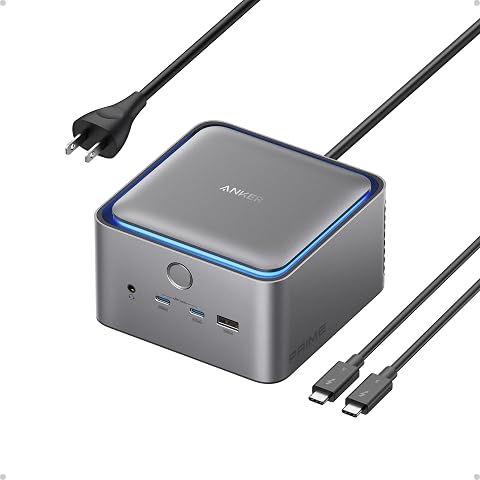
This 14-port docking station connects compatible laptops to Thunderbolt, USB, HDMI or DisplayPort, Ethernet, memory card, and audio peripherals. It supports up to 8K displays and provides up to 140W charging through its upstream Thunderbolt 5 port, with active cooling for use under load.
Pros:
- Wide selection of 14 ports, including Thunderbolt 5, Ethernet, card readers, and audio
- Supports high-resolution displays, including up to 8K@60Hz
- Provides up to 140W upstream charging with PD 3.1
- Active cooling system is designed to help manage heat under load
Cons:
- Dual 8K@60Hz support is specified for Thunderbolt 5 Windows laptops
- The two front USB-C ports share 45W of charging power
Best for: Workstations with a computer confirmed to support Thunderbolt 5
Not ideal for: Computers or peripherals whose requirements do not match the dock
Bottom line: Verify the exact computer, display, and power requirements against the dock’s full specifications.
Surge Protector Power Strip
A power strip helps organize the equipment connected at a workstation. The listed GE Surge Protector Power Strip with 2 Tethered USB Ports identifies surge protection and two tethered USB ports, but the product name does not give its outlet count, cord length, or electrical ratings. Check the full listing and compare those details with the devices and available wall outlet in your room.
A common mistake is assuming that every power strip will fit the desk layout or meet every device’s power requirements. Count the plugs you intend to connect, account for bulky adapters, and check spacing between outlets. Review the strip’s electrical ratings and surge specifications against the equipment and local requirements. Confirm the cord length reaches safely from the outlet to the intended location without stretching across a walkway. Check where the tethered USB ports are positioned and whether their reach suits the devices you want to charge. Avoid relying on a product name alone for electrical suitability; use the manufacturer’s specifications for the final check.
What to look for:
- Outlet count and spacing for planned plugs
- Electrical ratings and surge specifications
- Cord length for the outlet-to-desk route
- Reach and placement of the two tethered USB ports
- Fit with bulky adapters and the intended location
GE Surge Protector Power Strip with 2 Tethered USB Ports
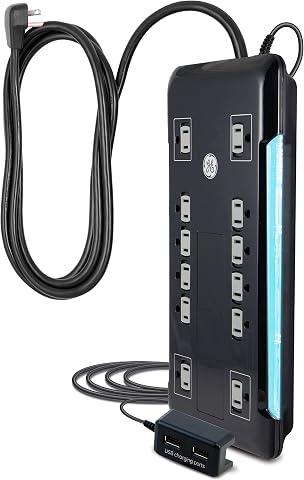
This surge protector features 12 outlets, including two USB ports for charging devices. It has an 8-foot extension cord, space-saving design, and surge protection with a 4320 joule rating, ensuring safety and reliability for home or office use.
Pros:
- Multiple outlets and USB ports for versatile charging
- Long extension cord for flexible placement
- High surge protection rating for safety
Cons:
- Limited to 120V electrical system
- No mention of smart or energy-saving features
Best for: Setups that can use the listed tethered USB ports
Not ideal for: Workstations requiring unverified outlet counts or electrical ratings
Bottom line: Confirm outlet spacing, cord reach, and electrical specifications for every device in the setup.
Build the workstation in fit-first order: measure the desk and chair area, then confirm the converter and monitor arm can be accommodated. Next check that the keyboard, mouse, dock, and power strip meet the requirements of your computer and connected equipment. Prioritize the details that affect your setup directly, such as dimensions, mounting, connection support, and electrical ratings.
Use the checklist as a practical starting point, then verify each specification with the product listing and your equipment manuals. A few careful measurements and compatibility checks can make it easier to assemble a remote newsroom workspace that suits your daily routine.