
Wireless lavalier microphones range from tiny phone plug-in kits to more flexible systems for cameras, interviews, and live events. My best overall pick is the Hollyland Lark M2 for its compact, versatile setup, while the DJI Mic 3 stands out for buyers who want a more capable multi-person kit, and the Mini Mic Pro keeps phone recording simple. The main tradeoffs are device compatibility, how many people you need to record, and whether you need a camera receiver or just a phone connector. A simpler mobile kit may be easier to carry, while a larger system can suit more recording situations. Read on for the full breakdown and help matching a mic to your setup.

Get everyday essentials delivered free with Prime
- Fast, free delivery on millions of items
- Prime Video, Amazon Music and more included
- Member-only deals all year
Complete the kit


Key Takeaways
The Lark M2 is the most balanced all-around choice in this lineup, with versions suited to both camera and USB-C recording; check the exact kit before buying.
The DJI Mic 3 is the strongest fit for buyers seeking a more capable two-transmitter system, while the smaller DJI Mic Mini kits focus on portable, simpler recording.
Phone-first kits dominate the compact end of the list. Mini Mic Pro, MAYBESTA, GoorDik, Amazpro, and wedaniya emphasize direct mobile use rather than broad camera flexibility.
TONOR’s UHF systems fill a different role from clip-on phone kits: their bodypack, headset, and multi-mic options make more sense for presentations and events than casual mobile video.
Receiver and connector details matter as much as the microphone. This list includes USB-C, Lightning, camera-oriented, and mixed-connector kits, so compatibility can outweigh extra features.
| Hollyland Lark M2 Wireless Lavalier Microphone System for Camera and USB-C |  | Best for Camera-and-Computer Flexibility | Wireless band: 2.4 GHz | Connectors: 3.5 mm jack and USB Type-C | Audio format: 48 kHz/24-bit | VIEW LATEST PRICE | See Our Full Breakdown |
| Mini Mic Pro Wireless Lavalier Microphone for iPhone and Android | 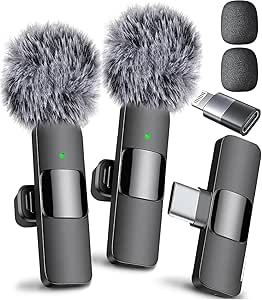 | Best for Simple Phone Recording | Wireless frequency: 2.4 GHz | Connectors: Lightning and USB Type-C | Compatible devices: Android devices, laptops, smartphones, tablets, iPads, and iPhones | VIEW LATEST PRICE | See Our Full Breakdown |
| Labstandard Dual Wireless Lavalier Microphone Set for iPhone and USB-C Devices |  | Best for Two-Person Smartphone Interviews | Wireless transmission: 2.4 GHz | Connectivity listed: Bluetooth | Connectors: Lightning and USB Type-C | VIEW LATEST PRICE | See Our Full Breakdown |
| TONOR 4-Microphone Wireless System with Handheld, Headset, and Lavalier Mics |  | Best for Events and Multi-Mic PA Setups | Wireless type: UHF | Operating range: Up to 200 ft (60 m) | Microphone pattern: Unidirectional (cardioid) | VIEW LATEST PRICE | See Our Full Breakdown |
| DJI Mic 3 (2 TX + 1 RX + Charging Case) Wireless Microphone |  | Best for Backup Recording and Multi-Person Production | Included system: 2 transmitters, 1 receiver, and charging case | Connectors: 3.5 mm jack and USB Type-C | Internal recording: 32-bit float | VIEW LATEST PRICE | See Our Full Breakdown |
| TONOR UHF Wireless Microphone System with Bodypack, Lavalier and Headset Mics |  | Best for PA and Presentation Use | Wireless type: UHF | Receiver connector: 6.35 mm (1/4-inch) jack | Included microphones: Lavalier and headset | VIEW LATEST PRICE | See Our Full Breakdown |
| DJI Mic Mini Wireless Microphone Kit with 2 Transmitters, Receiver, and Charging Case | 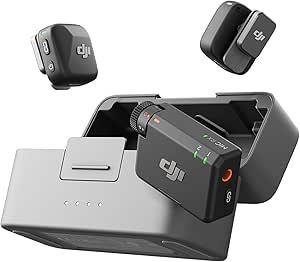 | Best for Long Recording Days | Included components: 2 transmitters, receiver, charging case, accessories | Transmitter weight: 10 g | Maximum transmission range: 400 m | VIEW LATEST PRICE | See Our Full Breakdown |
| GoorDik Wireless USB-C Lavalier Microphone with Noise Reduction |  | Best for Two-Person Phone Interviews | Transmitters: 2 | Connectors: USB Type-C, USB Type-A adapter, Lightning adapter | Compatible devices: Laptop, PC, smartphone, tablet | VIEW LATEST PRICE | See Our Full Breakdown |
| MAYBESTA Wireless Mini Lavalier Microphone for iPhone and Android |  | Best for Simple Phone Recording | Model: WM356-1 | Connectors: Lightning and USB Type-C | Included microphones: 2 lavalier microphones | VIEW LATEST PRICE | See Our Full Breakdown |
| DJI Mic Mini Wireless Microphone System (2 Transmitters, 1 Receiver) |  | Best Compact Two-Person Kit | Included components: 2 transmitters, 1 receiver, accessories | Transmitter weight: 10 g | Transmission range: Up to 400 m | VIEW LATEST PRICE | See Our Full Breakdown |
| TONOR UHF Wireless Microphone System with Headset and Lavalier Microphones |  | Best for Presentations and Longer-Range UHF Use | Wireless type: UHF | Operating range: Up to 200 ft (60 m), line of sight | Channels: 30 total; 15 adjustable frequencies per bodypack | VIEW LATEST PRICE | See Our Full Breakdown |
| Amazpro Wireless Lavalier Microphone for iPhone and Android |  | Best for Simple Phone Interviews | Wireless type: 2.4G | Receiver connectors: USB-C or Lightning | Microphones: 2 clip-on transmitters | VIEW LATEST PRICE | See Our Full Breakdown |
| Hollyland Lark M2 Wireless Microphone | 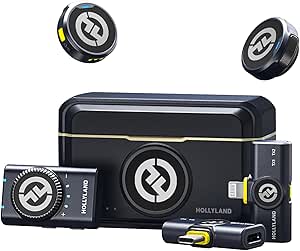 | Best for Lightweight, High-Quality Recording | Transmitter weight: 9 g | Audio format: 48 kHz/24-bit | Transmission range: Up to 300 m (1,000 ft), line of sight | VIEW LATEST PRICE | See Our Full Breakdown |
| DJI Mic Mini Wireless Microphone Kit (2 Transmitters, Mobile Receiver) |  | Best for Noise Control on USB-C Devices | Transmitters: 2 | Receiver: 1 mobile receiver | Transmitter weight: 10 g | VIEW LATEST PRICE | See Our Full Breakdown |
| wedaniya Wireless Lavalier Microphone Set, 2 Pack with USB-C and Lightning Receivers |  | Best for Cross-Device Phone Compatibility | Model: WM189 | Included microphones: 2 transmitters | Connectors: USB-C and Lightning | VIEW LATEST PRICE | See Our Full Breakdown |
More Details on Our Top Picks
Hollyland Lark M2 Wireless Lavalier Microphone System for Camera and USB-C
The Hollyland Lark M2 is the strongest fit here for creators who move between a camera and a computer: its receiver supports a 3.5 mm camera connection and direct USB-C computer use. Its 48 kHz/24-bit audio, mono and stereo options, and noise cancellation give it more recording flexibility than the phone-first Mini Mic Pro, though the stereo and mono switching applies only through the camera receiver’s 3.5 mm connection. The 9 g microphone is unobtrusive on clothing, while the camera-version case can extend total use to 40 hours. Its claimed 300 m range is a line-of-sight figure, not a promise for crowded or obstructed locations. I’d choose it over the TONOR system for compact camera work, but not for venues that need handheld mics or a 1/4-inch mixer connection.
Pros:- Direct USB-C receiver connection supports computer recording alongside 3.5 mm camera use.
- 48 kHz/24-bit audio and noise cancellation offer useful recording flexibility.
- Light 9 g microphone is less obtrusive when clipped to clothing.
- Camera-version charging case provides up to 40 hours of total use.
Cons:- Mono and stereo switching is limited to use with the camera receiver over 3.5 mm.
- The stated 300 m range applies to line-of-sight conditions.
- The listed battery details are less straightforward than a simple built-in rechargeable-battery specification.
Best for: Camera creators and interviewers who also want direct USB-C computer connectivity and long run time between charges.
Not ideal for: Phone-only creators seeking the simplest bundled mobile setup, or users who need dependable range through walls and other obstructions.
- Wireless band:2.4 GHz
- Connectors:3.5 mm jack and USB Type-C
- Audio format:48 kHz/24-bit
- Transmission range:Up to 300 m line of sight
- Battery life:Up to 10 hours per charge; up to 40 hours with camera-version charging case
- Signal-to-noise ratio:70 dB
- Maximum sound pressure level:115 dB
- Recording modes:Mono and stereo
Our verdict“Choose the Lark M2 if you need one compact lavalier system for both camera and USB-C computer recording.”
Mini Mic Pro Wireless Lavalier Microphone for iPhone and Android
The Mini Mic Pro makes the most sense for phone-first creators who want to start recording without an app or Bluetooth setup. Its included USB-C and Lightning adapters cover many current phones, tablets, and laptops, while two microphones let a single kit serve a basic two-person conversation. Foam and deadcat covers are practical additions for reducing wind noise outdoors. Compared with the Hollyland Lark M2, it is more focused on straightforward mobile use and offers fewer details about recording formats or camera connections. Its up-to-six-hour battery life also makes it less suited to long shoots than the Lark M2 with its camera-version case. The receiver-and-adapter arrangement is convenient across devices, but buyers should check their device’s port and compatibility before relying on it.
Pros:- Includes USB-C and Lightning adapters for a broad range of compatible mobile devices.
- No app or Bluetooth setup is required according to the product description.
- Two microphones make it practical for basic interviews.
- Foam and deadcat covers help manage wind noise.
Cons:- Up to six hours per charge is shorter than the Lark M2 system’s stated case-supported total.
- The supplied details do not specify audio resolution or a camera-oriented 3.5 mm connection.
- Battery-powered operation means the microphones need charging between sessions.
Best for: Phone-based vloggers and interviewers who want a two-mic kit with both USB-C and Lightning adapters and minimal setup.
Not ideal for: Camera crews or creators recording long sessions who need a specified camera input, extended battery capacity, or advanced format controls.
- Wireless frequency:2.4 GHz
- Connectors:Lightning and USB Type-C
- Compatible devices:Android devices, laptops, smartphones, tablets, iPads, and iPhones
- Microphone pattern:Omnidirectional
- Battery life:Up to 6 hours per charge
- Microphone count:2
- Included wind protection:Foam tips and deadcat tips
- Enclosure material:ABS
Our verdict“Pick the Mini Mic Pro for uncomplicated two-person phone recording across USB-C and Lightning devices.”
Labstandard Dual Wireless Lavalier Microphone Set for iPhone and USB-C Devices
For paired smartphone interviews, the Labstandard dual set puts two omnidirectional lavaliers and two-channel support at the center of the package. Its stated 0.008-second latency is aimed at keeping speech and picture closely aligned, while noise reduction and real-time syncing suit livestreams and conversational video. Like the Mini Mic Pro, it includes both Lightning and USB-C options and runs for about six hours; the Labstandard set, however, specifically describes dual-channel audio and a rechargeable Lightning adapter. That flexibility comes with caveats: its connectivity is listed as Bluetooth as well as 2.4 GHz transmission, and the battery information is internally unclear, listing two C batteries while also describing the set as rechargeable. I’d favor the Lark M2 for clearer camera-oriented specifications, but this is the more interview-focused pick for compatible mobile devices.
Pros:- Two microphones and two-channel support are suited to recording two speakers.
- The stated 0.008-second latency targets close audio-video synchronization.
- Includes Lightning and USB-C connectivity options.
- Noise reduction is included for interview and livestream use.
Cons:- The battery description is inconsistent, listing C batteries while also describing a rechargeable adapter.
- The product notes that compatibility and functions may depend on the device and instructions.
- Its approximately six-hour battery life is shorter than the Lark M2’s case-supported total.
Best for: Two-person interviewers, podcasters, and livestreamers recording on compatible Lightning or USB-C phones and tablets.
Not ideal for: Buyers who need unambiguous battery instructions, well-documented device compatibility, or a clearly specified camera workflow.
- Wireless transmission:2.4 GHz
- Connectivity listed:Bluetooth
- Connectors:Lightning and USB Type-C
- Microphone type:Omnidirectional condenser lavalier
- Channels:2
- Latency:0.008 seconds
- Battery life:Approximately 6 hours
- Included accessories:Receiver, rechargeable Lightning adapter, USB-C charging cable, and user manual
Our verdict“Choose the Labstandard set for dual-speaker mobile interviews if you are comfortable checking device and battery details before recording.”
TONOR 4-Microphone Wireless System with Handheld, Headset, and Lavalier Mics
The TONOR TW362 is the outlier in this lavalier roundup: it includes lavalier microphones, but its real advantage is a larger four-microphone-style kit with handheld and headset options for a PA system. Automatic pairing and a stated 200 ft range suit presentations, karaoke, or group events better than the compact, phone-oriented Mini Mic Pro. The tradeoff is a less mobile setup: its receiver connects through a 1/4-inch audio cable, so it needs a compatible mixer, amplifier, karaoke machine, or powered speaker rather than a direct phone connection. Each microphone or bodypack takes two AA batteries, which are not included. I’d choose it over the Hollyland Lark M2 when flexible mic formats and a PA input matter more than camera recording, discreet wear, or a USB-C workflow.
Pros:- Includes handheld, headset, and lavalier microphone options for different speakers and settings.
- Automatic pairing reduces setup steps between the receiver and microphones.
- Stated operating range is up to 200 ft (60 m).
- Bodypacks include a mute button.
Cons:- Requires a compatible 1/4-inch audio input and is not a direct phone-oriented system.
- Each microphone or bodypack needs two AA batteries, which are not included.
- Its receiver and multiple mic formats make it less compact than the Mini Mic Pro or Lark M2.
Best for: Event hosts, instructors, and small venues that need handheld, headset, and lavalier options feeding a compatible PA or mixer.
Not ideal for: Mobile video creators who need a pocketable receiver, direct phone or USB-C connection, or a simple camera lavalier setup.
- Wireless type:UHF
- Operating range:Up to 200 ft (60 m)
- Microphone pattern:Unidirectional (cardioid)
- Audio connector:1/4-inch (6.35 mm) Aux
- Compatible devices:Mixers, karaoke machines, amplifiers, and powered speakers
- Included microphone types:2 handheld, 2 headset, and 2 lavalier microphones
- Power:2 AA batteries per microphone or bodypack; batteries not included
- Signal-to-noise ratio:60 dB
Our verdict“Choose the TONOR system for a compatible PA setup that needs several microphone styles, not for mobile lavalier recording.”
DJI Mic 3 (2 TX + 1 RX + Charging Case) Wireless Microphone
The DJI Mic 3 is the most production-oriented option in this group, pairing two transmitters and a receiver with a charging case and 32-bit float internal recording. That onboard backup can preserve a take if the wireless link is disrupted, a safeguard the Hollyland Lark M2’s listed feature set does not provide. Adaptive gain control and dual-band anti-interference are also aimed at more demanding recording conditions, while the system can expand to support up to four transmitters and eight receivers according to the product information. Its tradeoffs are the higher system complexity and a stated 221.2 g item weight, which is less discreet than a 9 g Lark M2 microphone. The supplied specifications also contain unusual entries, including a 500 GHz frequency response, so I would verify technical details and device compatibility before purchase.
Pros:- 32-bit float internal recording provides an onboard backup of takes.
- Includes two transmitters, one receiver, and a charging case.
- Adaptive gain control and dual-band anti-interference target more challenging recording environments.
- Can expand to support up to four transmitters and eight receivers, according to the product information.
Cons:- The listed 221.2 g item weight is less discreet than the 9 g Hollyland Lark M2 microphone.
- The specification list includes a 500 GHz frequency response, an unusual figure that should be verified.
- Full compatibility with Osmo Mobile series devices requires the first-generation DJI OM Multifunctional Module.
Best for: Video teams and interviewers who value onboard backup recording, multi-person expansion, and a charging case for extended production days.
Not ideal for: Casual phone vloggers seeking a simple, lightweight lavalier, or buyers who need fully clear and consistent specification details before choosing.
- Included system:2 transmitters, 1 receiver, and charging case
- Connectors:3.5 mm jack and USB Type-C
- Internal recording:32-bit float
- Battery life:Up to 28 hours
- Number of channels:4
- Listed connectivity technologies:Bluetooth and Wi-Fi
- Item weight:221.2 g
- Listed frequency response:500 GHz
Our verdict“Pick the DJI Mic 3 when internal backup recording and multi-person expansion matter more than the simplest, lightest setup.”
TONOR UHF Wireless Microphone System with Bodypack, Lavalier and Headset Mics
I’d choose the TONOR UHF system when a lavalier needs to feed a PA, mixer, amplifier, or speaker rather than a phone or camera. Its 1/4-inch receiver output and bodypack make it a different kind of tool from the mobile-focused GoorDik USB-C Lavalier, which connects directly to compatible phones and computers. The TONOR also includes a headset mic, giving presenters a more secure option when a clip-on mic is poorly placed or clothing is noisy. Fifteen selectable frequencies and individual volume controls offer useful adjustment for a small venue. The tradeoff is a less grab-and-go setup: the receiver needs compatible audio gear, and the bodypack takes two AA batteries that are not included. I’d skip it for direct smartphone recording.
Pros:- Includes both lavalier and headset microphones for different speaking situations.
- Receiver connects to compatible PA systems, amplifiers, speakers, and mixers through a 1/4-inch jack.
- Bodypack provides an LCD, individual volume controls, and 15 selectable frequencies.
- Rechargeable receiver is rated for 6–8 hours of use.
Cons:- Cannot operate as a standalone phone or camera microphone; it needs compatible audio equipment.
- Bodypack requires two AA batteries, which are not included.
- Does not support Bluetooth or connection to soundbars and TVs.
Best for: Presenters, instructors, and small-event speakers who need a lavalier or headset mic connected to a PA system or mixer.
Not ideal for: Phone-first creators and anyone recording without a PA, amplifier, speaker, or mixer with a compatible 1/4-inch mic input.
- Wireless type:UHF
- Receiver connector:6.35 mm (1/4-inch) jack
- Included microphones:Lavalier and headset
- Wireless range:Up to 200 ft (60 m), line of sight
- Selectable frequencies:15 per bodypack
- Receiver battery life:6–8 hours
- Bodypack power:2 AA batteries, not included
- Compatible devices:Amplifier, speaker, PA system, mixer
Our verdict“Choose the TONOR when you need a flexible bodypack mic system for a PA, and skip it if your main recording device is a phone.”
DJI Mic Mini Wireless Microphone Kit with 2 Transmitters, Receiver, and Charging Case
The DJI Mic Mini kit with charging case stands out for creators who want two discreet transmitters and less battery anxiety across a long recording day. Its 10 g transmitters are suited to extended wear, while the case raises stated battery life to as much as 48 hours. That gives it an advantage over the DJI Mic Mini system without a charging case, whose supplied details list up to 10 hours per transmitter and receiver. Two noise-cancellation levels and automatic limiting also help manage changing environments and sudden loudness. The stated 400 m range is generous, though actual use depends on conditions. This kit is a stronger fit for phone and camera workflows than the PA-oriented TONOR system, but it is not waterproof, and direct OsmoAudio connection works only with compatible devices.
Pros:- Two 10 g transmitters are light for discreet, extended wear.
- Charging case supports up to 48 hours of stated battery life.
- Basic and Strong noise-cancellation levels provide different ways to manage background sound.
- Automatic audio limiting helps reduce clipping when voices or other sounds get louder.
Cons:- Not waterproof, which limits use in rain or wet environments.
- Direct receiver-free connection is limited to compatible OsmoAudio devices.
- Small parts and magnets require careful handling.
Best for: Mobile journalists and video creators who record with a phone or camera, need two mics, and value a charging case for extended shoots.
Not ideal for: Creators who record in wet conditions or want direct OsmoAudio use with devices outside the stated compatibility.
- Included components:2 transmitters, receiver, charging case, accessories
- Transmitter weight:10 g
- Maximum transmission range:400 m
- Sampling rate:48 kHz
- Audio bit depth:24-bit via direct OsmoAudio connection
- Battery life with case:Up to 48 hours
- Noise cancellation:Basic and Strong levels
- Connectivity:Bluetooth, DJI OsmoAudio, USB Type-C
Our verdict“Pick this kit for two-person mobile recording and long days between charging opportunities, but not for wet-weather shoots.”
GoorDik Wireless USB-C Lavalier Microphone with Noise Reduction
For interviews recorded on a compatible phone, tablet, or computer, the GoorDik USB-C set has a practical advantage: it supplies two transmitters and includes both foam covers and furry windscreens. That makes it more ready for two-person conversations and light outdoor use than the single-receiver, dual-microphone MAYBESTA WM356-1, whose supplied details do not specify runtime or range. GoorDik also offers noise-reduction and original-sound modes plus a mute function, so the user can choose between processing and a less altered sound. Its stated 6–12 hours per charge is useful, though the wide range leaves runtime less certain than a fixed figure. Some Android phones may need OTG enabled, and computer users may need to choose the mic as their input.
Pros:- Two transmitters support two-speaker interviews.
- Noise-reduction and original-sound modes, along with mute, give users recording controls.
- Foam covers and furry windscreens are included for indoor and outdoor use.
- Receiver USB-C port supports charging a phone while recording.
Cons:- Some Android phones may require OTG activation before the receiver works.
- Computer users may need to select the microphone as the default audio input.
- Stated battery life varies from 6 to 12 hours per charge.
Best for: Interviewers and small creator teams who record two speakers on compatible USB-C phones, tablets, or computers.
Not ideal for: Users who need guaranteed plug-and-play operation on every Android phone or want a microphone system with a precisely stated runtime.
- Transmitters:2
- Connectors:USB Type-C, USB Type-A adapter, Lightning adapter
- Compatible devices:Laptop, PC, smartphone, tablet
- Pickup pattern:Omnidirectional
- Battery life:6–12 hours per charge
- Wireless range:Up to 30 meters
- Frequency response:20–20,000 Hz
- Included wind protection:4 foam covers and 2 furry windscreens
Our verdict“Choose GoorDik for a two-person USB-C recording kit with useful wind accessories, provided your device supports its connection.”
MAYBESTA Wireless Mini Lavalier Microphone for iPhone and Android
The MAYBESTA WM356-1 is aimed at phone users who want a small lavalier setup without managing a separate camera receiver workflow. Its receiver has Lightning and USB-C connectors, and automatic pairing plus plug-and-play operation should make basic recording straightforward on compatible devices. Compared with the GoorDik Wireless USB-C Lavalier, MAYBESTA is framed more simply around mobile connection, while GoorDik provides more explicit battery and range figures along with wind accessories. MAYBESTA includes two lavalier microphones, a mute function, noise reduction, and sponge tips, making it useful for paired voices or backups. The major information gap is that battery runtime and wireless range are not specified. Its listed 2.4 GHz figure describes the wireless band, not an audio frequency response.
Pros:- Lightning and USB-C connectors support compatible iPhones and Android phones.
- Automatic pairing and plug-and-play operation simplify setup.
- Two lavalier microphones support recording two voices.
- Mute, noise reduction, and included sponge tips add useful recording controls and wind protection.
Cons:- Battery runtime is not specified.
- Wireless range is not specified.
- The listed 2.4 GHz figure is a wireless band, not an audio frequency-response specification.
Best for: iPhone and Android users who want a compact, automatically paired lavalier kit for casual mobile recording.
Not ideal for: Creators planning long shoots or recording at a distance who need published runtime and wireless-range figures.
- Model:WM356-1
- Connectors:Lightning and USB Type-C
- Included microphones:2 lavalier microphones
- Pickup pattern:Omnidirectional
- Special features:Mute, noise reduction, plug and play, automatic pairing
- Signal-to-noise ratio:80 dB
- Power:Battery powered
- Included accessories:USB charging cable, 2 sponge tips, 3 clips
Our verdict“Choose MAYBESTA for uncomplicated dual-mic phone recording, but look elsewhere if runtime and range need to be predictable.”
DJI Mic Mini Wireless Microphone System (2 Transmitters, 1 Receiver)
This DJI Mic Mini system is a compact choice for interviews, livestreams, and other recordings where two speakers need separate transmitters. At 10 g per transmitter, it is designed to stay unobtrusive, and two noise-cancellation levels plus automatic limiting help manage background sound and sudden peaks. Compared with the DJI Mic Mini kit with charging case, this package lists up to 10 hours of operating time for each transmitter and receiver but does not include a charging case, so it is less suited to long days without access to charging. The two systems share a stated range of up to 400 m, but range alone does not make this a fit for every setup. It is not waterproof, and OsmoAudio direct connection is limited to supported devices.
Pros:- Two 10 g transmitters suit discreet wear during interviews and video shoots.
- Two noise-cancellation levels provide a choice for different recording environments.
- Automatic limiting helps keep sudden loud sounds from clipping.
- Up to 10 hours of stated operating time per transmitter and receiver.
Cons:- No charging case is listed, unlike the other DJI Mic Mini kit in this roundup.
- Not waterproof.
- Osmo Mobile series connection requires the first-generation DJI OM Multifunctional Module.
Best for: Interviewers and livestreamers who want a lightweight two-transmitter kit and can recharge between recording sessions.
Not ideal for: Creators who need a charging case for extended field days, waterproof hardware, or guaranteed compatibility with unsupported Osmo devices.
- Included components:2 transmitters, 1 receiver, accessories
- Transmitter weight:10 g
- Transmission range:Up to 400 m
- Operating time:Up to 10 hours per transmitter and receiver
- Noise cancellation:Basic and Strong levels
- Direct connection audio:48 kHz, 24-bit
- Connectivity:Bluetooth, Wi-Fi
- Water resistance:Not waterproof
Our verdict“Pick this DJI kit for a light two-person setup with a receiver, but choose the charging-case version for longer days away from power.”
TONOR UHF Wireless Microphone System with Headset and Lavalier Microphones
The TONOR TW632 is the most presentation-focused option here: its two bodypacks can each use either a headset or lapel microphone, so speakers can keep their hands free and choose a fit that suits the room. Unlike the phone-first Amazpro and wedaniya kits, it sends audio to compatible gear through a 1/4-inch output, making it a better match for a PA system or other microphone input than direct mobile recording. Its 15 adjustable frequencies per bodypack give users some flexibility when managing wireless interference, and the stated range reaches 200 feet in line of sight. The tradeoff is a less self-contained setup: the receiver runs 6–8 hours per charge, while each bodypack needs two AA batteries that are not included. This is a practical choice for talks and classes, not the simplest pick for phone creators.
Pros:- Includes two bodypacks with both headset and lapel microphone options.
- Fifteen adjustable frequencies per bodypack provide channel flexibility.
- Rechargeable receiver offers 6–8 hours of use per charge.
- 1/4-inch output suits compatible PA and audio equipment.
Cons:- Each bodypack requires two AA batteries, which are not included.
- The 200-foot range is specified for line-of-sight use.
- The 1/4-inch receiver output is less convenient for direct phone recording than the Amazpro’s plug-in mobile receiver.
Best for: Presenters, instructors, and small event hosts who need two wearable microphones connected to compatible PA or audio equipment.
Not ideal for: Phone-first creators who want a receiver that plugs directly into USB-C or Lightning, or anyone who wants rechargeable bodypacks.
- Wireless type:UHF
- Operating range:Up to 200 ft (60 m), line of sight
- Channels:30 total; 15 adjustable frequencies per bodypack
- Microphones included:2 headset microphones and 2 lapel microphones
- Bodypacks:2; each uses 2 AA batteries, not included
- Receiver output:6.35 mm (1/4-inch) jack
- Receiver battery:Recharge time 2–3 hours; usage time 6–8 hours
- Signal-to-noise ratio:70 dB
Our verdict“Choose the TONOR TW632 for two-person talks or presentations on compatible 1/4-inch-input equipment, rather than for direct-to-phone recording.”
Amazpro Wireless Lavalier Microphone for iPhone and Android
The Amazpro is aimed at creators who want to start recording on a phone without managing Bluetooth pairing or an extra app. Its receiver plugs into a compatible USB-C or Lightning port, and automatic pairing keeps the setup simpler than the TONOR TW632’s separate bodypacks and 1/4-inch receiver. Two clip-on transmitters make it useful for interviews, while the charging case can recharge both microphones up to three times. Pass-through charging also lets a phone draw power while recording, a useful option for longer sessions. The main limitation is runtime: each microphone records for 3–4 hours per charge, shorter than the wedaniya set’s stated six hours. Its 65–100-foot range is also an unobstructed-condition figure, so it suits nearby phone recording better than demanding long-distance shoots. Check the receiver connector against your phone before choosing it.
Pros:- USB-C and Lightning receiver options connect directly to compatible phones.
- Automatic pairing avoids Bluetooth setup and third-party apps.
- Two transmitters support interviews and other two-person recordings.
- Charging case can recharge both microphones up to three times and the receiver supports pass-through phone charging.
Cons:- Recording time is 3–4 hours per charge, shorter than the wedaniya set’s stated maximum of six hours.
- The 65–100-foot range applies to unobstructed conditions.
- Plastic construction may be less reassuring for frequent rough handling than a metal-bodied system.
Best for: Phone-based interviewers and short-form creators who want two microphones, automatic pairing, and charging-case backup.
Not ideal for: Creators recording long sessions without breaks, or anyone who needs a stated recording time beyond 3–4 hours per microphone charge.
- Wireless type:2.4G
- Receiver connectors:USB-C or Lightning
- Microphones:2 clip-on transmitters
- Wireless range:20–30 m (65–100 ft), unobstructed
- Recording time:3–4 hours per charge
- Charging case:320 mAh; recharges both microphones up to three times
- Transmitter battery:50 mAh each
- Features:Noise reduction, mute, reverb, digital battery display, and automatic pairing
Our verdict“Pick the Amazpro for straightforward two-person phone recording when easy setup and charging-case backup matter more than longer per-charge runtime.”
Hollyland Lark M2 Wireless Microphone
The Lark M2 is the strongest fit here for creators who value a discreet mic and higher-resolution audio across camera, phone, and PC setups. Its transmitter weighs just 9 g, while 48 kHz/24-bit audio gives editors more detail to work with than the basic plug-and-play focus of the Amazpro. The stated 300 m line-of-sight transmission range and charging-case runtime also suit shoots where the speaker may move farther from the recording device. It is more capable, but not as simple in every configuration: stereo mode works only through the 3.5 mm camera connection, and noise cancellation must be switched on manually. The supplied data also lists up to 40 hours for the camera version but up to 10 hours with ENC off, so runtime depends on configuration. I’d favor it over the DJI Mic Mini when the listed audio format and system flexibility are priorities.
Pros:- 9 g transmitter is suited to discreet, comfortable on-camera wear.
- 48 kHz/24-bit audio supports detailed recording.
- Listed 300 m line-of-sight transmission range suits wider shooting setups.
- Noise cancellation and mono/stereo options provide recording flexibility.
Cons:- Stereo mode is limited to a camera connection through the 3.5 mm jack.
- Noise cancellation must be toggled manually.
- Listed battery life varies by version and settings, so the 40-hour figure does not apply to every configuration.
Best for: Video creators who want a very light wearable mic, detailed 24-bit audio, and compatibility across camera, phone, and PC workflows.
Not ideal for: Buyers who want one consistent stereo workflow across devices or automatic noise handling without manual mode changes.
- Transmitter weight:9 g
- Audio format:48 kHz/24-bit
- Transmission range:Up to 300 m (1,000 ft), line of sight
- Battery life:Up to 40 hours for camera version; up to 10 hours with ENC off
- Frequency response:20 Hz–20 kHz
- Connectivity:2.4 GHz; 3.5 mm, Lightning, and USB-C connectors listed
- Polar pattern:Omnidirectional
- Maximum SPL:115 dB
Our verdict“Choose the Lark M2 if you want a lightweight mic with detailed audio and flexible device support, and can work around its mode-specific features.”
DJI Mic Mini Wireless Microphone Kit (2 Transmitters, Mobile Receiver)
The DJI Mic Mini makes a persuasive case for mobile creators who want more control over noisy surroundings without stepping up to the Lark M2’s camera-focused connection options. Its two noise-cancellation levels let users choose between lighter processing and stronger suppression, while automatic audio limiting helps reduce clipping when a speaker suddenly gets louder. At 10 g per transmitter, it remains light enough for discreet wear, and its USB-C receiver supports compatible phones, PCs, and tablets. The listed 300 m range and up to 11.5 hours of operation provide flexibility, though the product data does not specify the conditions behind those maximums. This kit is not waterproof, and direct connection is limited to supported OsmoAudio devices. Compared with the wedaniya set, it offers more explicit noise-control options but lacks the listed Lightning receiver and real-time headphone monitoring.
Pros:- Two transmitters support two-person recording.
- Basic and Strong noise-cancellation settings suit different environments.
- Automatic limiting helps reduce clipping from sudden loud sounds.
- USB-C receiver works with compatible phones, PCs, and tablets.
Cons:- The system is not waterproof.
- The receiver uses USB-C, unlike the wedaniya set’s listed USB-C and Lightning options.
- Osmo Mobile series connection requires a first-generation DJI OM Multifunctional Module.
Best for: USB-C creators recording interviews, livestreams, or video in changing noise conditions who want two transmitters and adjustable noise cancellation.
Not ideal for: Lightning-only phone users, people recording in wet conditions, or creators who need receiver-based headphone monitoring.
- Transmitters:2
- Receiver:1 mobile receiver
- Transmitter weight:10 g
- Maximum transmission range:300 m
- Maximum operating time:11.5 hours
- Noise cancellation:2 levels: Basic and Strong
- Direct connection audio:48 kHz, 24-bit
- Connector and compatible devices:USB-C; compatible phones, PCs, and tablets
Our verdict“Choose the DJI Mic Mini mobile kit if you record on compatible USB-C devices and value adjustable noise cancellation and automatic level protection.”
wedaniya Wireless Lavalier Microphone Set, 2 Pack with USB-C and Lightning Receivers
The wedaniya set stands out for buyers who move between iPhone and Android devices: it includes both Lightning and USB-C receivers, whereas the DJI Mic Mini mobile kit listed here uses USB-C. Two transmitters, included wind covers, and real-time headphone monitoring make this a useful starter setup for interviews or outdoor clips where checking audio before a take matters. DSP noise reduction and Standard, Reverb, and Mute modes add practical control, though those options do not replace careful mic placement in a noisy setting. Its stated six-hour runtime is longer than the Amazpro’s 3–4 hours per charge, but still calls for charging between longer recording blocks. The compact receivers support a wider device mix, yet buyers should confirm that their chosen device can use the relevant connector and monitoring setup.
Pros:- Includes both USB-C and Lightning receivers for compatible devices.
- Real-time headphone monitoring helps catch audio problems while recording.
- DSP noise reduction and included deadcat and sponge covers address different noise sources.
- Up to six hours of recording time per charge.
Cons:- Six-hour maximum runtime may require recharging during longer recording days.
- The product data does not specify a wireless range.
- Requires charging before first use.
Best for: Creators and interviewers who record across Lightning and USB-C phones or tablets and want headphone monitoring and included wind protection.
Not ideal for: People who need recording sessions longer than six hours without charging, or those who prioritize a specified long-range transmission distance.
- Model:WM189
- Included microphones:2 transmitters
- Connectors:USB-C and Lightning
- Wireless frequency:4.8 GHz
- Recording time:Up to 6 hours
- Charging time:About 1 hour
- Audio features:DSP noise reduction; Standard, Reverb, and Mute modes
- Monitoring and accessories:Real-time headphone monitoring via receiver; 2 deadcat covers and 2 sponge covers included
Our verdict“Pick the wedaniya set if cross-device USB-C and Lightning compatibility, monitoring, and included wind covers matter more than extended runtime.”

How We Picked
I compared these 15 products by how well they address common lavalier recording jobs: mobile video, interviews, camera recording, and presentations. The main criteria were device compatibility, transmitter and receiver configuration, ease of setup, portability, and how useful each system is beyond one narrow recording scenario. I also weighed whether the kit’s included connections and microphone types match its likely use, since a phone-only receiver is not interchangeable with a camera receiver or an event-oriented bodypack system.
The ranking favors systems with a clear use case and fewer compromises for that role, rather than treating every feature as equally valuable. The Hollyland Lark M2 leads for its balance of compactness and kit flexibility; the DJI Mic 3 ranks highly for buyers who need a more capable multi-person setup. Phone-first options rank well for simple mobile recording but lower for versatility, while TONOR’s UHF systems are reserved for buyers whose priority is speech at events or presentations. Similar product names do not guarantee identical kits, so I distinguish models by their listed receiver and transmitter configurations.
Factors to Consider When Choosing Wireless Lavalier Microphones
Before choosing a wireless lavalier microphone, match the system to the recording setup you actually use. Small differences—such as a phone-only receiver versus a camera receiver, or one transmitter versus two—can affect daily use more than headline feature claims. These checks can help you avoid buying a kit that works well in general but does not fit your devices or recording routine.
Match the receiver to your recording device
Start by identifying where the audio will be recorded: a USB-C phone, Lightning phone, camera, or a combination of devices. A transmitter may attach to clothing in the same way across kits, but the receiver determines whether it can connect directly to your phone or camera. Mixed-connector sets, such as the wedaniya kit, can reduce the need to buy a separate receiver when switching between compatible phones. Do not assume that a USB-C connection guarantees compatibility with every phone or recording app; check the device and app requirements. If you record on both a phone and camera, a camera-oriented kit such as the Lark M2 camera-and-USB-C system may be a better fit than a phone-only option. Prioritize the receiver you need now over a connector you may never use.
Choose one or two transmitters based on your speakers
A single-transmitter kit can keep solo videos and voice notes straightforward, with fewer pieces to charge and manage. Two transmitters make more sense for interviews, co-hosted videos, or recording two people at once, but they add setup and coordination. Check whether the receiver supports the number of transmitters included in the package; similar product names can refer to different kit configurations. A two-transmitter bundle is not automatically better if you mostly record alone. If you expect group conversations, also think about how speakers will be positioned and whether each person can wear a mic consistently. Buying for the usual number of speakers is often more useful than buying the largest bundle available.
Decide between mobile simplicity and broader system flexibility
Phone plug-in kits are appealing when quick setup and minimal equipment matter most. Their small receivers suit short-form video and casual recording, but they may not offer the connection options needed for cameras or event sound systems. Larger systems can provide more routing choices or additional microphone types, yet they take more space and can require more setup steps. The TONOR UHF options, for example, are aimed at presentation and event use rather than pocketable phone recording. Consider where you record most often and how much equipment you are willing to carry. Paying for broader compatibility makes sense when you will use it; otherwise, a focused mobile kit may be easier to live with.
Treat noise reduction as one tool, not a fix for placement
Noise-reduction features can help manage steady background sound, but they cannot replace good microphone placement or a quiet recording position. A mic clipped too far from the speaker may capture more room noise and less direct voice, even when processing is available. Strong processing can also alter how a voice sounds, so listen to a sample before relying on it for every situation. Outdoor recording adds wind as a separate problem; look for suitable wind protection rather than assuming electronic noise reduction will handle it. For interviews, place and check each transmitter before recording instead of waiting until editing to discover uneven audio. A clean source recording usually gives you more control than aggressive processing.
Account for clothing, movement, and visibility
A tiny clip-on mic is easy to carry, but its position can affect both sound and appearance. Clothing friction, loose fabric, jewelry, and body movement may create unwanted noise, so plan where the mic can sit securely. Visible transmitters are acceptable in many creator videos, while a presentation or formal interview may call for a less noticeable placement. Headset and bodypack options can be more practical when a speaker moves around or needs a consistent microphone position. Test the setup with the clothing and movements you expect during the actual recording. A comfortable mic that stays in place is more useful than a discreet one that shifts or rubs.
Check what is included and what you must supply
Compare the actual package contents, not only the product name or image. Kits may differ in receiver type, transmitters, charging case, microphone accessories, and phone connectors, even when they share a model family. A charging case can make a compact kit easier to keep ready, while a receiver without the connector you need can require another purchase or adapter. Confirm whether the kit includes the number of transmitters required for your recording and whether its charging approach fits your routine. For UHF systems, check what components are needed to connect to the venue’s sound equipment. Reading the configuration details before checkout can prevent a mismatch that no audio feature can fix.
Frequently Asked Questions
Can I use one wireless lavalier microphone kit with both my phone and camera?
Sometimes, but the receiver and included connections determine whether that is practical. A kit listed for both camera and USB-C use, such as the Hollyland Lark M2 camera-and-USB-C version, is a clearer match for switching devices than a phone-only set. Some kits may need an adapter, and an adapter does not guarantee that every camera or recording app will work correctly. Check the receiver outputs and your device’s input requirements before buying. If you regularly switch between a phone and camera, choose a bundle that explicitly supports both rather than relying on assumptions.
Do I need two transmitters for interviews?
Two transmitters are useful when you want separate microphones on both people, which can make an interview easier to record and edit. A single mic can work if the speakers stay close together, but the audio balance may vary as they move or turn. The DJI Mic 3 and several DJI Mic Mini configurations in this roundup include two transmitters, while phone-first options may be configured differently. Confirm that the exact bundle includes a receiver that can handle both transmitters. If you mostly make solo recordings, the extra transmitter may add gear without improving your usual workflow.
Are phone plug-in microphones a good choice for recording video?
They can be a convenient choice when your main goal is recording directly to a compatible phone. Models such as the Mini Mic Pro, MAYBESTA, GoorDik, and Amazpro are oriented toward mobile use, so they can suit simple creator workflows. Their main limitation is that a phone-focused receiver may not connect directly to a camera or event sound system. Confirm the connector matches your phone and check whether your preferred recording app accepts an external mic. If you later plan to add camera recording, a more versatile receiver may save you from replacing the whole setup.
Should I choose a compact creator mic or a UHF system for presentations?
For a short phone video or a seated interview, a compact creator kit is usually easier to carry and set up. Presentations and events can call for a different approach, especially when the speaker moves across a room or needs a headset option. The TONOR UHF systems in this list include bodypack, headset, or multiple microphone types, making them more suited to that kind of use than the small phone receivers. Before choosing one, check how it connects to the venue’s amplification equipment and what microphone style the speaker can wear comfortably. A larger system is worthwhile only if its event-oriented connections and formats match your setup.
What should I check if a wireless mic is not recording on my phone?
First confirm that the receiver’s connector matches the phone and that the connection is fully seated. Then check whether the recording app supports an external microphone and whether the phone is routing audio to the receiver rather than its built-in mic. Test the setup with a short recording and playback before filming a full session. If you use an adapter, verify that it supports audio input rather than charging alone. These checks are especially useful when comparing USB-C, Lightning, and receiver-specific bundles, since a similar-looking plug does not guarantee the same function.
Conclusion
For most buyers, I recommend the Hollyland Lark M2 as the best overall because it balances a compact form with a more flexible camera-and-USB-C configuration. For a more capable two-person setup, the DJI Mic 3 is my best premium pick; buyers focused on simple phone recording should compare the Mini Mic Pro and other mobile-first kits against their exact connector needs. As a value-minded choice, I would start with a focused phone kit such as the Mini Mic Pro rather than paying for camera or event features you will not use. For beginners, a compact, direct-to-phone option offers a simpler entry point, provided it matches the phone. For presentations and events, choose a TONOR UHF system when its headset or bodypack format and venue connections fit your setup. Match the receiver, number of speakers, and recording environment first; those choices narrow the list quickly.